

Your first solo trip can feel like standing at the edge of a diving board, exciting and terrifying in equal measure. You want the freedom, the adventure, the personal growth everyone talks about. But you also have a dozen questions running through your head about safety, budgeting, and whether you'll actually enjoy eating dinner alone. That's exactly why having solid solo travel tips for beginners matters before you book anything. The right preparation turns nervous energy into genuine confidence.
At Nexttrip.Travel, we help travelers design personalized, curated journeys, and we've seen firsthand how solo travelers thrive when they start with a clear plan. Whether you're drawn to a wellness retreat in Bali or a cultural deep dive through Europe, traveling alone doesn't mean figuring everything out alone.
This guide breaks down nine practical tips covering planning, safety, and actually enjoying your own company on the road. By the end, you'll have a straightforward framework for approaching your first solo adventure, no fluff, just the stuff that genuinely makes a difference when it's just you and your passport.
1. Use Nexttrip.Travel to build a solo-friendly plan
Planning your first solo trip without structure leads to decision fatigue before you even leave home. Nexttrip.Travel cuts through that by giving you concierge-level planning built around your specific travel style, timeline, and comfort level, so you start with a complete framework rather than a blank page.
What to do
Start by visiting Nexttrip.Travel and browsing the curated itineraries designed around real destinations. Choose a trip style that matches your interests, whether it's a wellness retreat, a cultural city break, or a beach escape. From there, the platform handles flights, hotels, and activities, pulling everything into a single organized plan. You don't need to cross-reference twelve browser tabs or second-guess your choices at every turn.
Why it works for beginners
Most beginner solo travelers lose hours researching destinations, only to feel less certain by the end. Nexttrip.Travel removes that loop by giving you expert-curated routes that have already been tested by real travelers and local insiders. You get the benefit of someone else's on-the-ground experience without needing to have it yourself yet.
A well-structured itinerary does more than save time. It gives you a confidence anchor when things feel overwhelming on the road.
Common mistakes to avoid
The biggest trap beginners fall into is over-planning every hour of the trip or, on the opposite end, booking nothing beyond a flight. Both approaches create unnecessary stress. Another mistake is ignoring personalization options, treating a curated itinerary as fixed when it's actually designed to flex around your preferences and pace.
- Don't book the cheapest flight without checking arrival times
- Don't skip travel insurance because it feels optional
- Don't fill every day back-to-back with activities
Quick checklist
Before you finalize your plan through Nexttrip.Travel, run through these steps to make sure your foundation is solid as one of your core solo travel tips for beginners:
- Set a clear trip budget
- Choose a destination type that suits your comfort level
- Confirm your passport validity
- Review your selected itinerary details before payment
- Add at least one buffer day for rest or unexpected changes
2. Pick a beginner-friendly destination and trip length
Your destination choice sets the tone for everything else on your first solo trip. Picking somewhere logistically manageable and English-friendly reduces friction so you can focus on enjoying the experience rather than constantly troubleshooting.
What to do
Start with countries that rank well for solo traveler safety and infrastructure, such as Japan, Portugal, New Zealand, or Thailand. Look for destinations with reliable public transport, clear signage, and a strong tourism support network. Keep your first trip short, between five and ten days, so you get the full experience without exhausting yourself before you even hit your stride.
Why it works for beginners
A shorter trip to a well-traveled destination gives you room to make small mistakes without serious consequences. You build confidence gradually rather than overwhelming yourself with a six-week route across multiple countries right out of the gate.
Choosing a manageable destination on your first solo trip is one of the most underrated solo travel tips for beginners, because it keeps your energy focused on enjoying rather than surviving.
Common mistakes to avoid
Many first-timers pick a destination based purely on social media trends without checking visa requirements or language barriers. Others book trips that are too long, burning out by day seven and spending the rest of the trip counting down to home.
Quick checklist
- Confirm visa requirements for your passport
- Check safety ratings for solo travelers
- Choose a trip length of five to ten days
- Research English-language availability at your destination
3. Book the right place to stay for safety and comfort
Where you sleep shapes your entire solo trip experience. The right accommodation gives you a secure base to return to, easy access to local transport, and a social environment that makes meeting people feel natural rather than forced.
What to do
Prioritize centrally located hotels or hostels with strong solo traveler reviews on major booking platforms. Look for properties offering 24-hour reception, secure key card access, and lockers for valuables.
- Choose a hostel with private rooms or a mid-range hotel in a walkable neighborhood
- Confirm the property has secure storage for passports and electronics
- Read at least 20 recent reviews before committing to a booking
Why it works for beginners
Staying somewhere well-reviewed and centrally located cuts your daily navigation stress immediately. You spend less time figuring out late-night transport options and more time actually experiencing the destination the way you planned.
Your accommodation choice is one of the most overlooked solo travel tips for beginners, but it directly affects how safe and confident you feel throughout the entire trip.
Common mistakes to avoid
Booking the cheapest option available without reading recent reviews is a common trap for first-timers. Avoid properties in isolated areas if you're arriving late at night, and skip any listing with repeated complaints about security or unresponsive staff.
- Don't book based on price alone
- Avoid accommodation far from public transport
Quick checklist
Run through these before confirming your stay to keep safety and comfort balanced:
- Confirm 24-hour front desk availability
- Check walking distance to transport hubs
- Verify secure storage for valuables
4. Plan arrivals, departures, and local transport in advance
Arriving in a new city without a clear transport plan is one of the fastest ways to turn excitement into stress. Knowing exactly how you're getting from the airport to your hotel, and how you'll move around each day, removes a major source of first-day anxiety that catches many solo beginners off guard.
What to do
Research your airport-to-accommodation route before you board the plane. Identify whether you'll use a metro line, airport bus, or licensed taxi, and save the route offline using Google Maps. Check local transport options for day-to-day movement, including day passes or transit cards that offer better value than individual fares. Book airport transfers in advance for late-night arrivals when fewer options are available.
Why it works for beginners
Having a confirmed transport plan means you land with direction rather than confusion. This is one of the most practical solo travel tips for beginners because it protects your energy from the moment you step off the plane, leaving more of it for the actual experience.
The first two hours in a new city shape how you feel about the entire trip, so make those hours as smooth as possible.
Common mistakes to avoid
Avoid relying entirely on mobile data for navigation without downloading offline maps first. Don't assume taxis outside the airport are metered or safe without checking local guidance.
Quick checklist
- Download your route offline before departure
- Confirm airport transfer booking for late arrivals
- Research local transit card options
- Save your accommodation address in the local language
5. Set up a simple safety system before you go
Having a safety system in place before your trip doesn't require complicated preparation. It just means making sure the right people know where you are and that you have backup options ready if something goes wrong.
What to do
Share your full itinerary with at least one trusted person at home, including hotel names, addresses, and flight details. Set up a regular check-in schedule, such as a quick message every evening confirming you're safe. Store digital copies of your passport, travel insurance, and bookings in a cloud service like Google Drive so you can access them from any device if your bag gets lost or stolen.
Why it works for beginners
This is one of the most underrated solo travel tips for beginners because a safety system reduces panic in difficult situations. When someone at home knows your movements, you have a built-in support network without needing to rely entirely on strangers.
A five-minute setup before departure can save you hours of stress if something goes wrong on the road.
Common mistakes to avoid
Many first-timers skip this step entirely, assuming nothing will go wrong. Don't rely on memory alone for important details, and avoid storing all your key documents in one place.
Quick checklist
Run through these steps before your departure date to confirm your system is solid:
- Share your itinerary with a trusted contact
- Set a daily check-in time
- Upload key documents to Google Drive
- Carry a backup card separate from your main wallet
6. Pack light and keep your essentials easy to access
How you pack directly affects how freely you move and how quickly you can react when plans shift. Solo travelers carry everything themselves, so every extra kilo you bring is a problem only you have to solve.
What to do
Stick to one carry-on bag and one personal item for trips up to ten days. Choose clothing in neutral colors that mix and match easily, limiting yourself to three to five outfits you can rewear. Keep your passport, cards, phone, and medication in a dedicated front-facing pocket or crossbody bag you never check into the overhead bin. Pack a small day bag for sightseeing that folds flat inside your main luggage.
Packing light is one of the most freeing solo travel tips for beginners because it keeps you mobile, reduces theft risk, and eliminates baggage fees entirely.
Why it works for beginners
A lighter pack means faster movement through airports, easier navigation on public transport, and less to worry about in crowded spaces. When you're not wrestling with heavy luggage, you have more mental space to stay aware of your surroundings.
Common mistakes to avoid
Avoid packing "just in case" items that add weight without adding real value. Don't store all your valuables in your checked bag, and never keep your passport at the bottom of your main luggage where it's hard to reach quickly.
Quick checklist
- Limit yourself to one carry-on bag
- Pack a compact day bag
- Keep documents and cards in a secure front pocket
- Leave room for small purchases or souvenirs
7. Make it easy to meet people without overcommitting
Solo travel doesn't mean forced isolation or constant socializing. The right social setup lets you connect with other travelers when you want company and pull back when you need space, without committing to either extreme.
What to do
Choose accommodation with common areas like hostel lounges, co-working spaces, or rooftop terraces where conversation happens naturally. Sign up for one group activity per destination, such as a walking tour or cooking class, to meet people without the pressure of initiating conversations from scratch. Local community boards or hotel concierge desks often list low-commitment events worth attending.
Why it works for beginners
Structured group settings remove the awkwardness of approaching strangers cold. When you're on a walking tour or a group day trip, shared experience does the social heavy lifting for you, making this one of the most effortless solo travel tips for beginners to put into practice.
The best connections on a solo trip happen when you remove the pressure and just show up to something you'd genuinely enjoy.
Common mistakes to avoid
Don't over-schedule social activities out of fear of being alone. Forcing connection drains your energy fast and means you miss the quiet self-discovery that most solo travelers say is the most valuable part of the experience.
Quick checklist
- Book accommodation with common social spaces
- Join one group activity per destination
- Keep plans flexible enough to accept or decline invitations
8. Use your phone as your travel toolkit
Your phone is the most powerful solo travel tool you own, and setting it up correctly before departure takes less than an hour. The right apps and settings mean you move through each day with more confidence and less friction, even in places where you don't speak the language.
What to do
Download your core apps before you leave home so you're not scrambling for Wi-Fi on arrival. Install Google Maps for offline navigation, Google Translate for real-time language support, and a local ride-hailing app for the destination you're visiting. Set your phone to airplane mode with Wi-Fi on to avoid unexpected roaming charges, and pick up a local SIM card or international data plan as soon as you land.
Why it works for beginners
A fully loaded phone removes the guesswork that drains energy on a first solo trip. Offline maps mean you navigate confidently without needing a signal, and a translation app handles menus, signs, and conversations that would otherwise leave you stuck. This ranks among the most practical solo travel tips for beginners because it gives you immediate independence in any situation.
Your phone becomes your navigator, translator, and safety net all at once when you set it up properly before departure.
Common mistakes to avoid
- Relying on hotel Wi-Fi as your only data source
- Forgetting to download offline maps before you board
Quick checklist
- Download Google Maps offline for your destination
- Install a translation app
- Purchase a local SIM or data plan
- Charge a portable power bank before every day out
9. Manage solo travel anxiety and stay flexible
Solo travel anxiety is completely normal on your first trip, and it doesn't signal that you're not ready. Feeling nervous before or during a solo journey is one of the most common experiences beginners report, so treat it as a sign you care about the trip rather than a reason to abandon it. The key is having practical tools to manage that anxiety so it doesn't end up driving your decisions on the road.
What to do
Build flexibility into your daily schedule by leaving at least one unplanned hour each day. When anxiety spikes, give yourself permission to slow down, sit somewhere quiet, or swap a planned activity for a short walk. Use a simple grounding technique like controlled breathing to reset before making any reactive decisions about your plans.
Why it works for beginners
Rigid itineraries make anxiety worse because every small disruption feels like failure. A flexible schedule acts as a buffer, turning unexpected changes into natural detours. This is one of the most important solo travel tips for beginners because how you handle surprises shapes the entire tone of your trip.
Flexibility isn't a lack of planning. It's what allows your plan to survive contact with reality.
Common mistakes to avoid
Don't compare your real experience to the polished content you see on social media. Avoid overscheduling your days out of anxiety, because a packed itinerary leaves no room to breathe or adapt when things shift.
Quick checklist
- Leave one unplanned hour each day
- Identify a calming strategy to use when stress peaks
- Accept that itinerary changes are part of the experience
Your first solo trip, simplified
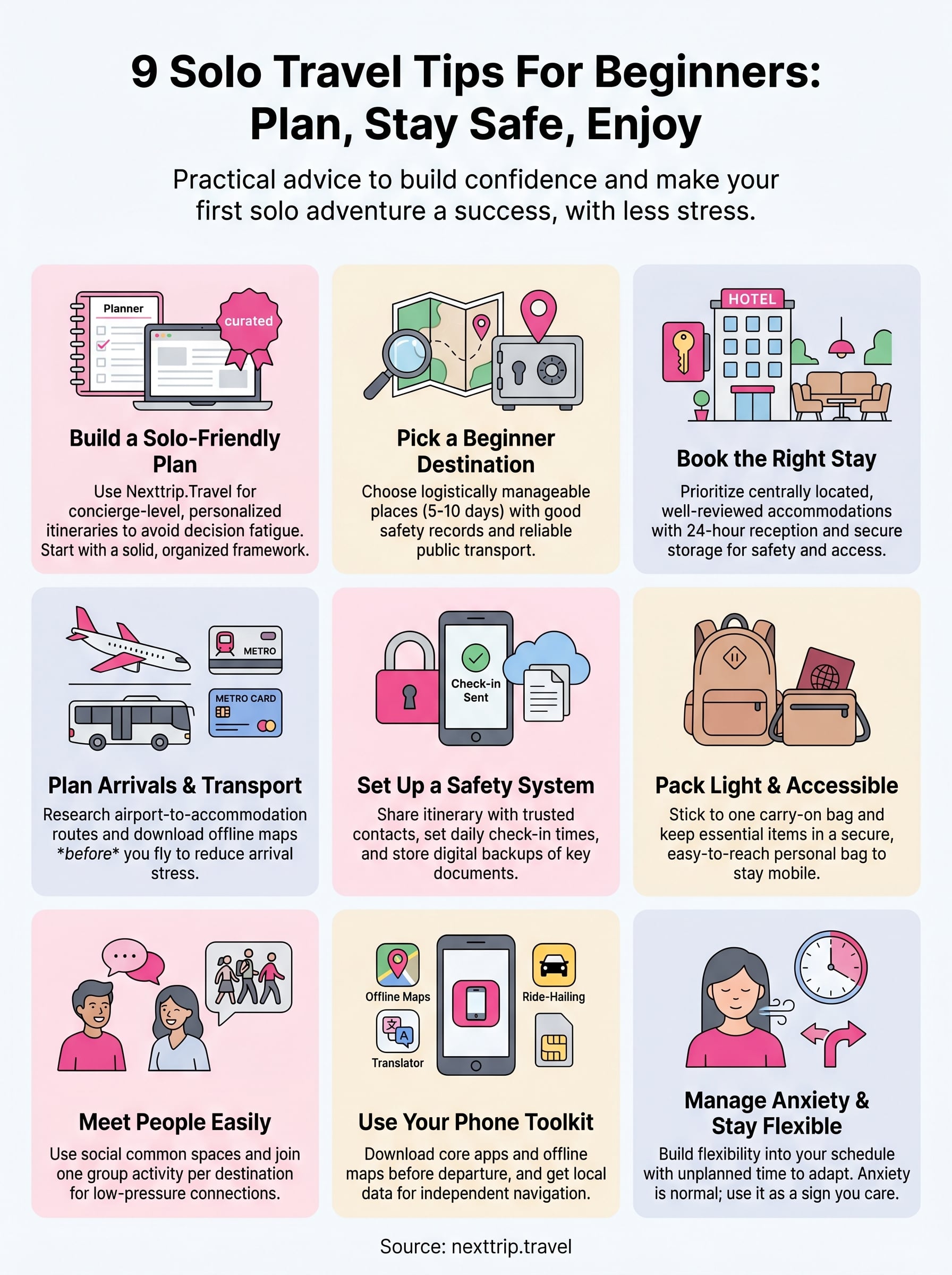
These nine solo travel tips for beginners cover everything from choosing your destination to managing anxiety when plans shift. None of them require experience you don't have yet. They just require a little preparation before you leave and the willingness to adapt once you arrive.
Solo travel rewards people who plan with intention but hold their plans loosely. The nervousness you feel now is the same thing every solo traveler felt before their first trip, and most of them look back on it as one of the best decisions they ever made.
Start with a destination that excites you, build a clear and flexible itinerary, and lean on expert support when you need it. Plan your first solo journey with Nexttrip.Travel and get a curated, concierge-designed experience built around your travel style so you spend less time planning and more time living it.