

You love exploring new places, you just don't love the idea of forced small talk at hostel breakfast tables or group tours with strangers who won't stop chatting. That's not a flaw. It's a preference. And these solo travel tips for introverts exist because traveling alone should recharge you, not drain you. The good news? Solo travel actually suits introverts better than most people realize.
The real challenge isn't being alone, it's designing a trip that respects your energy. Choosing the right accommodation, planning downtime between activities, and knowing when to engage (and when to skip the group dinner) makes all the difference between a trip you survive and a trip that actually fills you up. It takes intention, not personality change.
At Nexttrip.Travel, we build personalized itineraries tailored to how you actually travel, not how travel companies assume everyone travels. Whether you want a quiet villa in Bali or a self-guided cultural route through Kyoto, our concierge team designs trips around your pace, your preferences, and your comfort level. Here are six tips to help you plan solo travel entirely on your terms.
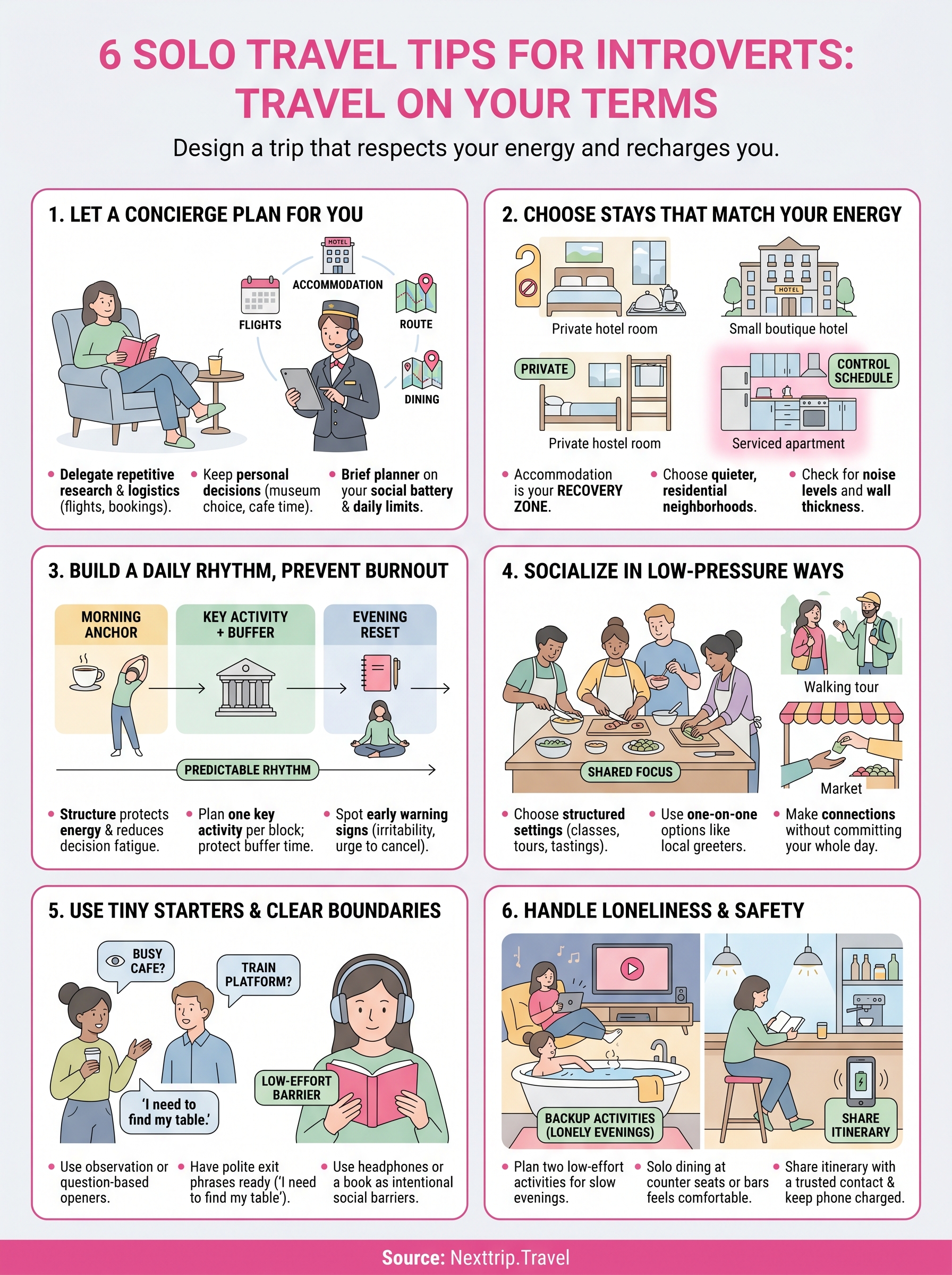
1. Let a concierge plan the trip for you with NextTrip.Travel
The biggest energy drain for introverts isn't the trip itself, it's the endless planning decisions before you even pack a bag. Researching accommodation options, figuring out which neighborhoods are too noisy, comparing transport routes, and pre-booking restaurants to avoid crowds all pile up fast. Delegating that research to a concierge frees your mental energy for the actual travel experience.
What to delegate and what to keep personal
Hand off anything that involves repetitive research or logistics: flights, hotel shortlisting, transfers, activity bookings, and restaurant reservations. These tasks eat time without rewarding you creatively. Keep the personal decisions to yourself, specifically things like which museum you visit first, how long you stay at a café, or whether you skip an activity entirely on a slow day. Those choices shape the emotional texture of your trip, and only you know what you need in the moment.
How to brief your planner so the trip fits your social battery
When you connect with a Nexttrip.Travel concierge, come with a short, honest brief. Tell them your daily energy limit (for example, two activities maximum per day), your preferred interaction style (solo dining vs. group settings), and any hard nos like loud bars or packed tourist sites at peak hours. The more specific you are, the better the itinerary reflects how you actually travel. This is one of the most practical solo travel tips for introverts: treat your social battery like a real constraint, not an apology.
A good planner designs around your limits, not despite them.
How to keep the itinerary flexible once you land
Ask your concierge to build in at least one unscheduled half-day block per three days of travel. This gives you a genuine reset window, not just a rushed lunch break. If something on the itinerary stops feeling right when you arrive, contact the concierge directly and swap it out without guilt. Nexttrip.Travel handles the rebooking so you don't have to navigate cancellation policies or language barriers mid-trip.
2. Choose stays that match your social energy
Where you sleep shapes how much energy you carry into each day. As an introvert, your accommodation isn't just a place to store luggage. It's your recovery zone, and picking the wrong one makes every outing harder than it needs to be.
Hotel, boutique stay, hostel private room, or apartment
Each option comes with a different social load. Standard hotels offer anonymity and room service, which means zero forced interaction. Boutique stays feel more personal but often include communal breakfasts. Private hostel rooms give you the budget benefit without the dormitory noise, though shared bathrooms require brief social tolerance. Serviced apartments win for longer trips because you control your schedule entirely, cook your own meals, and skip the lobby altogether.
The best accommodation for an introvert is the one that feels like a refuge, not a social commitment.
Neighborhood and room features that reduce overwhelm
Book in quieter residential neighborhoods rather than entertainment districts. A room on a higher floor, away from street noise, reduces ambient stress significantly. Look for properties with in-room dining options so you can eat privately after a full day out.
Booking checks that protect sleep and quiet time
Before confirming, check reviews specifically for noise levels and wall thickness. Filter for properties that offer late checkout, because a rushed morning wrecks your reset. These small pre-booking checks are among the most underrated solo travel tips for introverts.
3. Build a daily rhythm that prevents social burnout
Structure protects your energy. Without a loose daily routine, small decisions accumulate and decision fatigue hits you before you even reach the first activity. A predictable rhythm gives your nervous system a baseline, so the unpredictable parts of travel feel exciting rather than exhausting.
Use a simple morning anchor and an evening reset
Your morning anchor can be as small as a consistent coffee order at the same café or a 10-minute walk before checking your itinerary. It signals to your brain that the day starts on your terms. An evening reset does the opposite: it marks the end of output mode, whether that's journaling, a long shower, or simply sitting quietly with no screens for 20 minutes.
A predictable start and end to each day gives you two guaranteed recovery points, no matter what happens in between.
Plan one key activity per block and leave buffer time
Divide your day into morning, afternoon, and evening blocks. Assign one main activity per block, then protect the gaps between them. That buffer time is not wasted; it's where you process, decompress, and decide whether you have energy for something extra or need to head back earlier.
Spot early warning signs and adjust before you crash
Introvert burnout sneaks up gradually. Watch for irritability, difficulty making simple decisions, or a sudden urge to cancel plans you were excited about the day before. These are signals, not weakness. When you notice them, cut the next activity short and return to your accommodation without guilt. This kind of self-awareness is one of the most underrated solo travel tips for introverts.
4. Socialize in low-pressure ways that feel natural
Socializing on a solo trip does not have to mean forcing yourself into loud group dinners or hostel common rooms. The key is choosing settings with built-in structure, where the activity does the social heavy lifting and you can participate at whatever level feels comfortable. These approaches are some of the most effective solo travel tips for introverts because they reduce the performance pressure completely.
Pick structured settings like classes, tours, and tastings
A cooking class, a walking tour, or a wine tasting gives every participant a shared focus that isn't each other. Conversation happens naturally around the activity, so you never need to manufacture it. You can contribute as much or as little as you want, and leaving at the end requires zero explanation.

Structured activities give you a reason to be in the room that has nothing to do with socializing.
Use one-on-one options like local greeters and guides
A private local guide removes group dynamics entirely. You get genuine conversation, local knowledge, and a relaxed pace without managing the energy of strangers around you. Many cities offer free or low-cost greeter programs that match solo travelers with locals for a few hours of casual exploration.
Make connections without committing your whole day
Short interactions work well. A brief chat at a market stall or a quick recommendation exchange at a café counts as genuine connection without locking you into a full-day commitment with someone you just met.
5. Use tiny conversation starters and clear boundaries
Knowing when to open a conversation and when to close one gives you full control over your social exposure. These skills are practical tools, not personality traits, and learning them is one of the most useful solo travel tips for introverts because they work in any country, any language, and any situation.
Three opener types that do not feel forced
The easiest openers are observation-based, question-based, or compliment-based. Saying "I noticed this café is always busy, worth the wait?" works because it invites a short answer and places zero pressure on either person. A direct question like "Do you know which platform the train leaves from?" is functional and naturally time-limited.
Short, specific openers get genuine responses without opening the door to an hour-long conversation you did not plan for.
Polite exits that protect your time and safety
Keep two exit phrases ready: "I need to find my table" or "I want to catch the next part of the tour." Both are polite, truthful enough, and require no explanation. Using them confidently signals that you are ending the interaction, not rejecting the person.
When to use headphones, a book, or your phone on purpose
Visible headphones or an open book send a clear social signal without a single word. Wearing them in transit, at cafés, or in hotel lobbies gives you a low-effort barrier that most people instinctively respect.
6. Handle loneliness and safety without overthinking it
Loneliness and safety concerns are two of the most common reasons introverts hesitate before booking a solo trip. Both are manageable with light preparation, and neither requires you to become a different person to handle them well.
Plan two backup activities for lonely evenings
Before you travel, write down two low-effort activities you can do alone on a slow evening: a film at a local cinema, a bookshop browse, or a long bath with a downloaded playlist. These are not failure options. They are intentional choices that protect your mood when the day runs out of steam. Having them ready stops you from spiraling into indecision when your energy is already low.
Loneliness on a solo trip usually hits hardest in the early evenings, so planning for that window specifically makes a real difference.
Solo dining and nightlife tactics that feel comfortable
Sitting at a counter seat or bar table removes the awkwardness of a table built for two. Bring something to read or a downloaded podcast so the silence feels chosen, not imposed. For nightlife, a single drink at a quieter bar beats forcing yourself into a crowded venue you will resent within ten minutes.
Safety basics for introverts who prefer low visibility
Share your daily itinerary with one trusted contact back home, including accommodation details. Keep your phone charged, carry a portable battery, and choose well-lit, populated routes after dark. These are core solo travel tips for introverts: stay visible enough to be safe, invisible enough to stay comfortable.
Travel your way
Solo travel as an introvert works when you stop treating your needs as obstacles and start treating them as design parameters. Every tip in this list exists to help you build a trip that matches your energy, not someone else's idea of what adventure looks like. These solo travel tips for introverts are not about avoiding people or staying in your room. They are about traveling with intention so you arrive home feeling restored.
The biggest shift is planning from the start with your social battery in mind. Choosing the right accommodation, structuring your days around recovery, and knowing how to exit a conversation early are all skills that make solo travel genuinely enjoyable rather than just manageable. You do not need to push through discomfort to prove something.
When you are ready to plan a trip built entirely around how you travel, let Nexttrip.Travel design your next journey.