

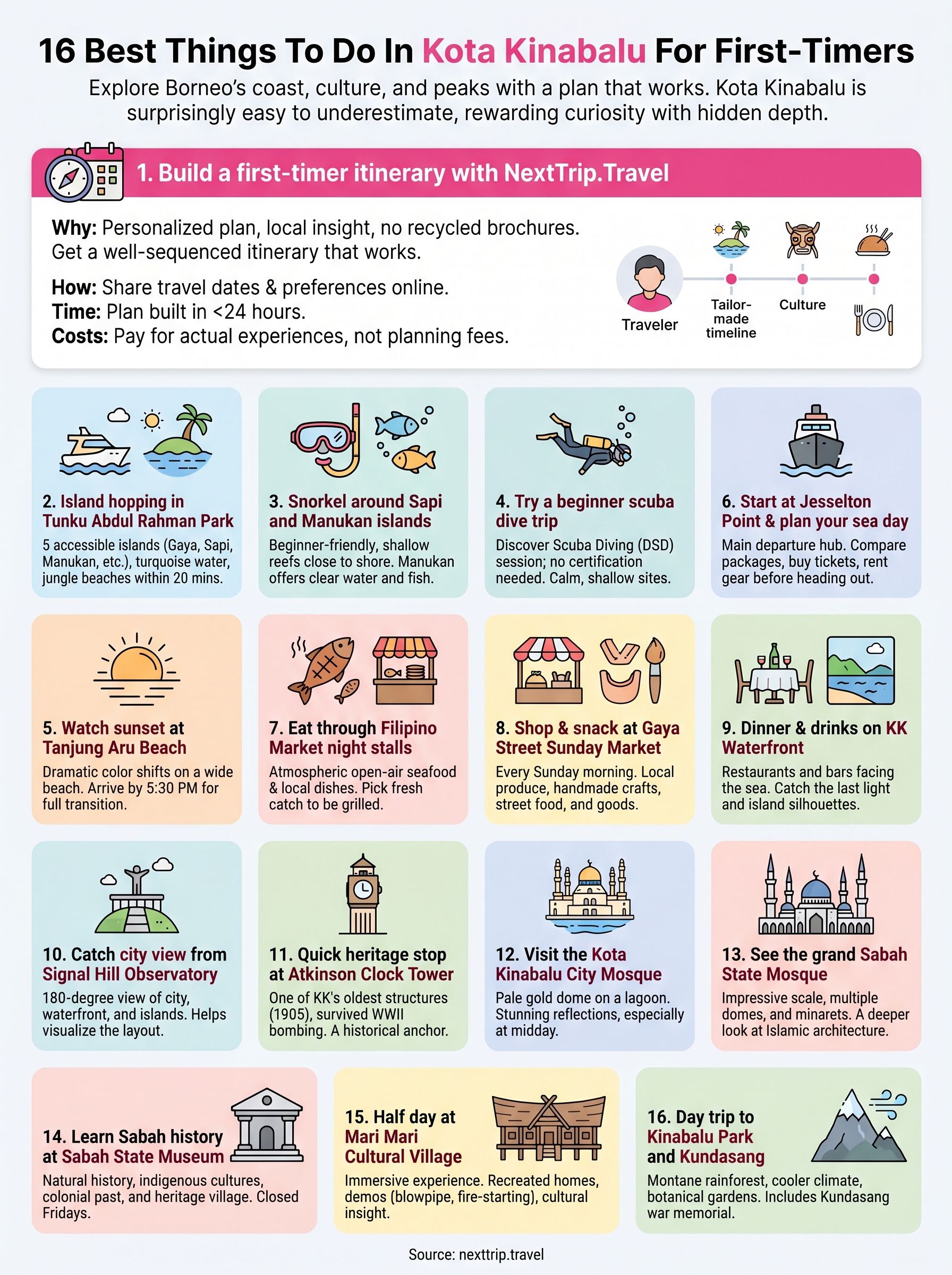
Kota Kinabalu sits on the northwest coast of Borneo, where rainforest-covered mountains meet the South China Sea. It's the kind of place that rewards curiosity, whether you're hopping between islands, eating your way through night markets, or standing at the foot of Southeast Asia's tallest peak. If you're searching for the best things to do in Kota Kinabalu, you're already making a solid choice for your next trip.
But here's the thing: KK (as locals call it) is surprisingly easy to underestimate. Most first-timers only scratch the surface, hitting one or two tourist spots before moving on. The city and its surroundings have far more depth than that, from cultural landmarks and wildlife encounters to sunsets that genuinely stop you mid-sentence.
At Nexttrip.Travel, we build itineraries around real, lived experiences, the kind that come from local insight and on-the-ground knowledge, not recycled travel brochures. This guide pulls from that same approach. Below, you'll find 16 of the best things to do in Kota Kinabalu as a first-time visitor, organized to help you plan smarter and experience more, whether you have three days or a full week.
1. Build a first-timer itinerary with NextTrip.Travel
Planning your first trip to Kota Kinabalu from scratch takes more time than most people expect. Between choosing islands, booking ferry slots, and figuring out which cultural sites to prioritize, the logistics alone can eat hours. NextTrip.Travel removes that friction by building a personalized KK itinerary around your travel style, timeline, and actual interests.
Why it belongs on your first trip
First-timers in KK face a real problem: there are too many things to do in Kota Kinabalu and not enough days to fit them all in. Without a structured plan, you end up rushing through highlights or missing them entirely. NextTrip.Travel connects you with local travel experts who know which combinations of activities actually work in a single day and which ones need more breathing room.
A well-sequenced itinerary means you spend your time experiencing KK, not figuring out logistics on the ground.
How to do it
Visit nexttrip.travel, share your travel dates, group size, and preferences, and the concierge team builds a tailored plan for you. You can request a mix of outdoor adventures, cultural stops, and food experiences, or focus on one area if your trip is short. The platform covers accommodation suggestions, activity bookings, and transport links in one place.
Time and typical costs
Building your itinerary takes less than 24 hours once you submit your details. Costs vary based on how much of the trip you want handled end-to-end, but concierge planning support is available across different budget levels. You pay for the actual experiences and stays, not a separate planning fee on top.
Tips for a smoother visit
Submit your request at least two weeks before arrival to give the team time to secure bookings, especially for popular island day trips and cultural village tours that fill quickly. Also consider the following when submitting your brief:
- Mention any dietary restrictions upfront
- Flag mobility needs so activities are accessible
- Specify whether you prefer packed days or a slower pace
Best photo and content spots
Your NextTrip itinerary can be built around content-ready destinations, spots chosen for both their experience value and their visual potential. Ask the team to flag the best time of day at each location, from golden hour at Tanjung Aru Beach to soft morning light at Kinabalu Park, so your photos actually match the moment you're there.
2. Go island hopping in Tunku Abdul Rahman Park
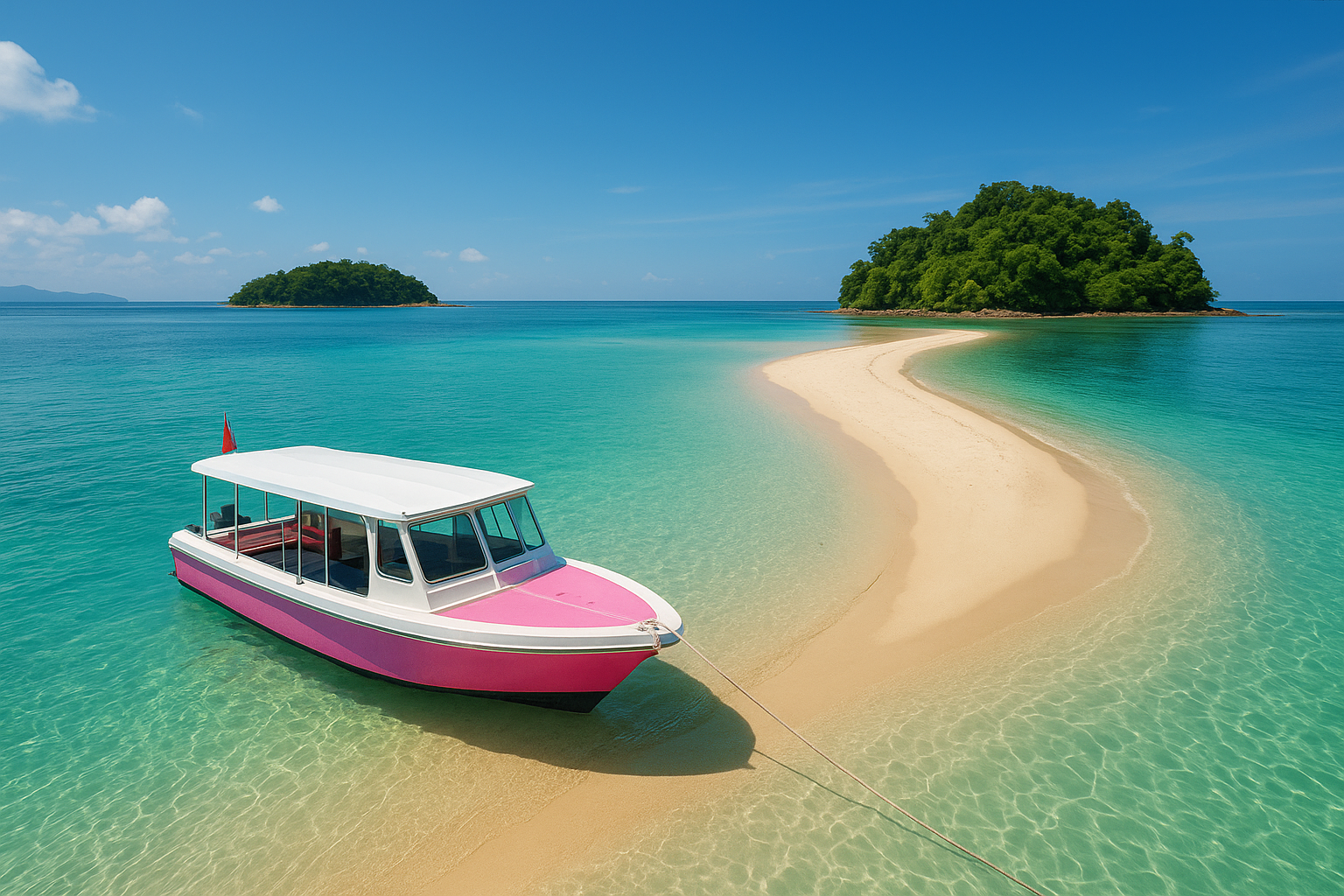
Tunku Abdul Rahman Park sits just 15 to 20 minutes by boat from the KK city ferry terminal, making it one of the most accessible marine parks in Malaysia. The park covers five islands: Gaya, Sapi, Manukan, Mamutik, and Sulug, each with its own character and crowd level.
Why it belongs on your first trip
Island hopping is one of the top things to do in Kota Kinabalu for a reason. You get turquoise water, white sand, and jungle-backed beaches within half an hour of leaving the city. For a first-timer, it delivers the full Borneo coastal experience without requiring a long journey or advanced planning.
Most visitors only visit one island, but covering two or three in a single day gives you a much richer sense of what the park offers.
How to do it
Board a water taxi from Jesselton Point Ferry Terminal and head to your chosen islands. Most boats operate on a shared basis, so you pay per person per trip. You can purchase a multi-island hop package on arrival at the terminal.
Time and typical costs
Plan for a full day, roughly 8 AM to 4 PM. A return boat ticket to one island costs around RM 23 to RM 35 per person. Island entrance fees are RM 10 for Malaysian residents and RM 15 for international visitors.
Tips for a smoother visit
Arrive at Jesselton Point before 9 AM to beat the midday crowd. Bring reef-safe sunscreen, as standard sunscreen damages the coral.
Best photo and content spots
The sandbar between Sapi and Gaya at low tide produces some of the most striking wide-angle shots in the park. Shoot facing west in the late afternoon for the best light and water color.
3. Snorkel around Sapi and Manukan islands
Sapi and Manukan are the two most snorkel-friendly islands in Tunku Abdul Rahman Park. Sapi has shallow reef patches close to shore, while Manukan offers longer stretches of coral and calmer water on its southern side. Together, they give you two distinct underwater environments within a single day trip.
Why it belongs on your first trip
Snorkeling here ranks among the most accessible things to do in Kota Kinabalu for first-timers. You don't need certification, special gear, or a boat charter. The reefs sit close enough to the beach that you can wade in and start exploring within minutes of arriving.
Manukan's southern reef consistently delivers the clearest water and the highest concentration of reef fish in the park.
How to do it
Rent snorkel gear directly from vendors at each island's beach for around RM 15 to RM 20 per set. You can also bring your own if you prefer a better mask fit. Enter the water from the designated snorkel zones marked by buoys to avoid boat traffic.
Time and typical costs
Allow two to three hours per island if you want to explore the reef properly. Gear rental adds RM 15 to RM 20 on top of your boat and entrance fees from the previous stop.
Tips for a smoother visit
Snorkel before 11 AM when water visibility is at its best and boat traffic is lower. Avoid touching or standing on coral, as even minor contact causes damage.
Best photo and content spots
Shoot from the surface looking down at the coral beds near Manukan's south beach during mid-morning. The shallow depth and clear water produce bright, detailed underwater shots without a dive camera.
4. Try a beginner scuba dive trip from Kota Kinabalu
Scuba diving is one of the most rewarding things to do in Kota Kinabalu if you've never dived before. The islands inside Tunku Abdul Rahman Park offer calm, shallow dive sites that work perfectly for first-timers, and several operators run certified introductory programs directly from the city.
Why it belongs on your first trip
A discover scuba diving (DSD) session lets you experience the underwater world without needing a full certification. Instructors take you through the basics in a controlled setting before guiding you into the water, so you spend less time in a classroom and more time actually diving.
Most first-timers who try a DSD session in KK leave wanting to complete their full Open Water certification on the same trip.
How to do it
Book a DSD session through a PADI-certified dive operator at Jesselton Point or Sutera Harbour. Operators provide all gear, a briefing session, and a certified dive guide. You descend to a maximum depth of 12 meters under direct supervision, making it suitable for complete beginners.
Time and typical costs
The full experience, including briefing and two dives, takes around four to five hours. Prices typically range from RM 280 to RM 380 per person, covering gear, boat transfer, and the guided dive.
Tips for a smoother visit
Avoid eating a heavy meal within two hours of your dive to reduce the chance of nausea. Bring a change of dry clothes and a small towel for the boat ride back.
Best photo and content spots
Ask your dive guide to photograph you near the coral formations at around 8 meters depth. Natural light at that depth produces vivid color without needing an external flash.
5. Watch sunset at Tanjung Aru Beach
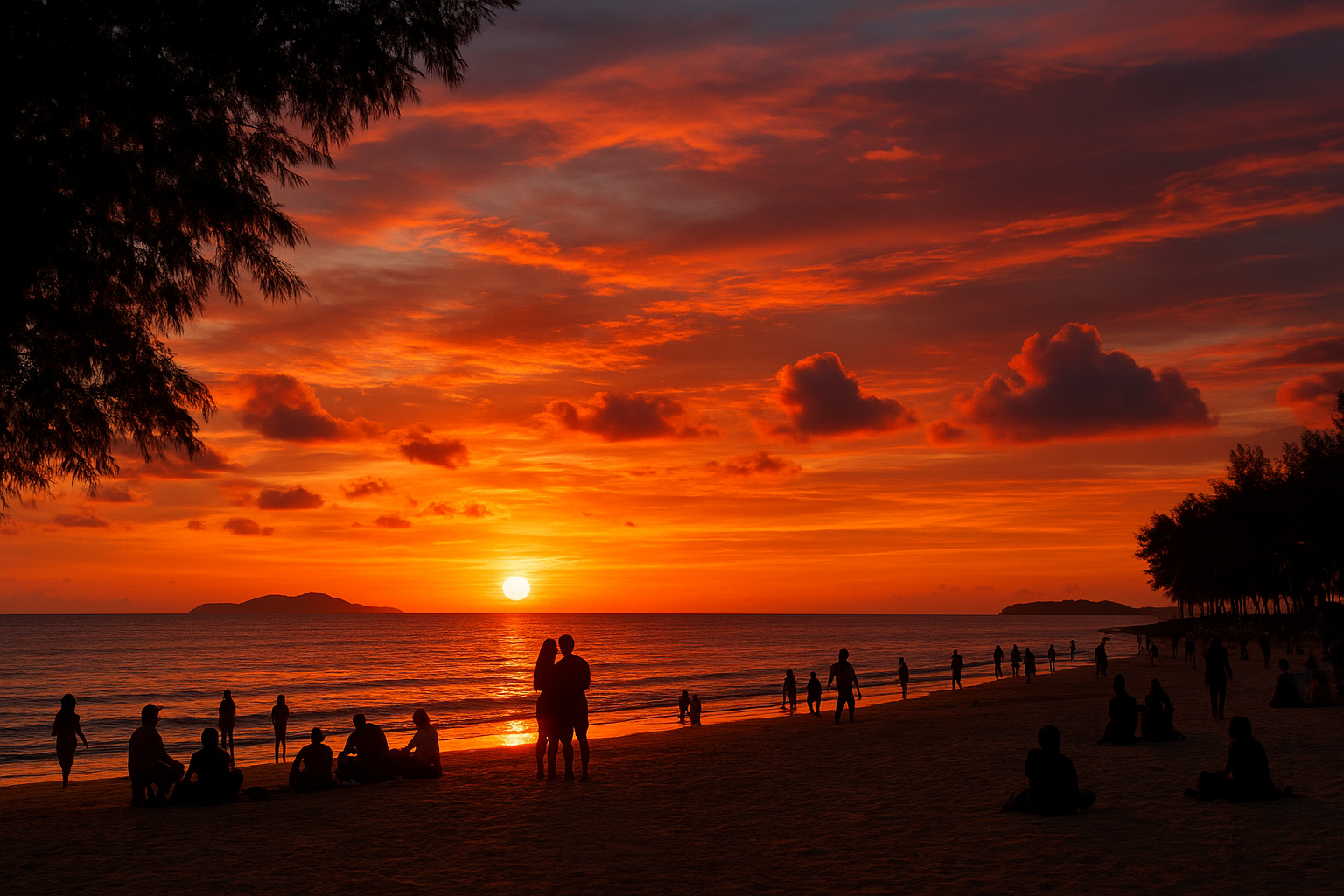
Tanjung Aru Beach sits about 5 kilometers south of the city center and is one of the most popular things to do in Kota Kinabalu in the early evening. The beach faces west over the South China Sea, giving you an unobstructed horizon at dusk. Local families, couples, and food vendors fill the area as the sun drops, creating a relaxed, lived-in atmosphere that most tourist spots in the city can't match.
Why it belongs on your first trip
The sunsets here are genuinely among the best in Malaysia, and that's not an overstatement. The wide beach, open horizon, and frequent cloud formations combine to produce dramatic color shifts from golden orange to deep red almost every clear evening.
Arriving at least 45 minutes before sunset gives you time to find a good spot and watch the full transition from daylight to dusk.
How to do it
Take a Grab ride from the city center, which costs around RM 8 to RM 12. The beach is free to enter, and several food stalls and small restaurants line the northern end near the Tanjung Aru Beach Resort area.
Time and typical costs
Plan to arrive by 5:30 PM and stay until around 7 PM. Other than food and drinks from vendors, there's no entrance cost involved.
Tips for a smoother visit
Bring insect repellent for the sandflies that appear after sundown. Weekday evenings are significantly quieter than weekends if you prefer a more relaxed setting.
Best photo and content spots
Position yourself slightly north of the main beach area where the tree line frames the horizon on one side. Shoot with the sun directly ahead for silhouette shots, or turn 90 degrees to capture the warm side light on other visitors and the shoreline.
6. Start at Jesselton Point and plan your sea day
Jesselton Point Ferry Terminal is the main departure hub for everything water-related in Kota Kinabalu. If island hopping, snorkeling, or scuba diving are on your list of things to do in Kota Kinabalu, this is where your day starts and ends.
Why it belongs on your first trip
Most first-timers head straight to the islands without realizing that Jesselton Point itself is worth arriving at early and exploring properly. The terminal has ticketing counters, gear rental stalls, and tour operator booths all in one place, so you can compare island packages and pricing before committing to a boat.
Spending 20 minutes at Jesselton Point before you book anything saves you from overpaying or choosing an island that doesn't match what you want to do.
How to do it
Walk through the ground-floor terminal and compare the multi-island hop packages offered at different counters. Prices and departure times vary slightly between operators. Once you decide, buy your tickets, pass through the gate, and wait at the designated jetty for your scheduled boat.
Time and typical costs
Arrive by 8 AM to catch the earliest boats and avoid the midday heat on the water. Entry to the terminal area is free, and boat tickets run RM 23 to RM 35 per person for a return trip to most islands.
Tips for a smoother visit
Bring cash since most counters don't accept cards. Keep your return ticket somewhere accessible because you hand it in when boarding the boat back to the mainland.
Best photo and content spots
The waterfront walkway just outside the terminal gate frames the islands on the horizon against the city skyline. Shoot facing northwest in the early morning for clean, uncrowded compositions with strong natural light.
7. Eat your way through the Filipino Market night stalls
The Filipino Market near the waterfront is one of the most atmospheric things to do in Kota Kinabalu after dark. Rows of open-air stalls serve grilled seafood, local noodles, and fresh coconut drinks in a setting that feels genuinely local rather than staged for tourists.
Why it belongs on your first trip
This market gives you direct access to Sabah's Filipino-influenced food culture in a format that's easy to navigate even on your first night. You walk the stalls, point at what looks good, and eat at communal tables alongside locals, making it one of the most honest food experiences the city offers.
The freshest seafood sells out early, so arriving before 7:30 PM gives you the widest selection.
How to do it
Walk through the stall rows near the waterfront and compare what's on display before committing. Vendors will often gesture you over and show you the day's catch. Order grilled fish, tiger prawns, or chicken satay directly from the stall and take it to one of the open tables nearby.
Time and typical costs
The market runs from roughly 5 PM to midnight. A full meal with drinks costs around RM 25 to RM 50 per person, depending on the seafood you order.
Tips for a smoother visit
Carry small denomination ringgit notes since most vendors don't break large bills easily. Confirm the price of seafood before it goes on the grill to avoid surprises at the end.
Best photo and content spots
Shoot from the end of a stall row looking inward during early evening to capture the glow of cooking flames and the full depth of the market in a single frame.
8. Shop and snack at the Gaya Street Sunday Market
Gaya Street Sunday Market runs every Sunday morning along one of the oldest streets in Kota Kinabalu, transforming the road into a long stretch of stalls selling local produce, handmade crafts, street food, and everyday goods. It draws both locals doing their weekly shop and visitors looking for a genuine taste of Sabah street life.
Why it belongs on your first trip
For anyone building a list of things to do in Kota Kinabalu, this market delivers something most tourist attractions can't: a real sense of how the city actually functions on a weekend morning. The mix of Kadazan-Dusun handicrafts, fresh tropical fruit, and local snacks puts Sabah's cultural diversity in front of you in a single walk.
Arriving before 8 AM gives you the first pick of produce and handmade goods before the crowds thin out the best stalls.
How to do it
Walk along Gaya Street from one end to the other before doubling back to buy. This approach lets you compare stalls and spot the best offerings before committing. Pick up bamboo crafts, fresh rambutans, and local kuih as you go.
Time and typical costs
The market runs from 7 AM to around 12 PM, Sundays only. Most snacks cost RM 2 to RM 5, and small handicraft items typically run RM 10 to RM 30.
Tips for a smoother visit
Bring a reusable bag since vendors rarely provide packaging. Cash in small denominations keeps transactions quick.
Best photo and content spots
Shoot the overhead canopy of vendor awnings from street level in the early morning light for a layered, colorful composition.
9. Have dinner and drinks on the Kota Kinabalu Waterfront
The Kota Kinabalu Waterfront stretches along Jalan Tun Fuad Stephens and holds a solid lineup of restaurants, bars, and casual dining spots facing the South China Sea. For first-timers deciding on things to do in Kota Kinabalu in the evening, this strip offers the easiest and most scenic dinner option in the city.
Why it belongs on your first trip
Eating here puts you at the water's edge with views of the Tunku Abdul Rahman Park islands glowing in the last light of the day. The atmosphere shifts from relaxed to lively as the night progresses, making it a good fit whether you want a quiet dinner or a full evening out.
Arriving at the waterfront between 6:30 PM and 7 PM means you catch the last of the sunset colors while securing a table before the dinner rush fills the better spots.
How to do it
Walk the waterfront strip and look at menus before sitting down. Options range from seafood grills and local Malay dishes to Western-style bars with cocktail menus. Most restaurants allow walk-ins, though reservations are worth making on weekends.
Time and typical costs
Plan for two to three hours starting around 6:30 PM. Budget between RM 40 and RM 100 per person, depending on whether you order alcohol and which restaurant you choose.
Tips for a smoother visit
Book a window or terrace table directly with the restaurant the day before for the best sea-facing views. Weeknights are noticeably quieter than Fridays and Saturdays.
Best photo and content spots
Shoot from the restaurant terrace looking west just after sunset, when the sky holds residual color and the island silhouettes sit clearly on the horizon.
10. Catch the city view from Signal Hill Observatory
Signal Hill Observatory sits above the city center and gives you a full 180-degree view over Kota Kinabalu, the waterfront, and the islands of Tunku Abdul Rahman Park stretching out to sea. The short climb or drive up to the platform takes less than 10 minutes from the city, making it one of the most time-efficient things to do in Kota Kinabalu for first-timers who want context and scale.
Why it belongs on your first trip
Seeing the city from above changes how you understand the layout of KK. From Signal Hill, you can spot the ferry terminal, the waterfront strip, and the five islands of Tunku Abdul Rahman Park all at once, which helps you visualize how your days fit together.
Standing at the observatory early in your trip gives you a mental map that makes every other stop feel more connected.
How to do it
You can reach the observatory by car, Grab, or a short uphill walk from the city center. The access road is straightforward, and the platform itself is small but well-maintained with open railings and clear sightlines in multiple directions.
Time and typical costs
Allow 30 to 45 minutes for the visit. Entry is free, and a Grab from the city center costs around RM 7 to RM 10 each way.
Tips for a smoother visit
Visit in the late afternoon between 4 PM and 5:30 PM when the light is warm and the haze typical of midday has usually cleared.
Best photo and content spots
Shoot from the northwest corner of the platform to capture the islands and the waterfront together in a single wide frame.
11. Take a quick heritage stop at Atkinson Clock Tower
The Atkinson Clock Tower stands on a small hill near the Signal Hill area and holds the distinction of being one of Kota Kinabalu's oldest surviving structures. Built in 1905, the wooden clock tower was constructed as a memorial to Francis George Atkinson, the first district officer of the settlement. It's a compact stop, but it carries more historical weight than its size suggests.
Why it belongs on your first trip
Among the heritage-focused things to do in Kota Kinabalu, Atkinson Clock Tower offers a grounding moment in the city's colonial history. Most of KK's original buildings were destroyed during World War II, which makes this tower one of the few physical connections to the city's pre-war identity that you can still stand in front of.
The tower survived the wartime bombing that flattened most of the surrounding area, which is why it stands almost alone on its hill today.
How to do it
The tower sits at the base of Signal Hill, accessible on foot from the city center in roughly 10 minutes. Walk up the short paved path leading to the platform and read the heritage plaques on site before heading onward.
Time and typical costs
Allow 15 to 20 minutes for the visit. Entry is completely free, and you can combine it with a Signal Hill Observatory stop on the same short outing.
Tips for a smoother visit
Visit in the morning or late afternoon to avoid direct sun exposure on the exposed hilltop path. The site has no shade structures, so plan your timing accordingly.
Best photo and content spots
Frame the tower against the backdrop of the city below by positioning yourself slightly downhill and shooting upward. Early morning light hits the white wooden structure cleanly from the east, giving you crisp, well-lit shots without harsh shadows.
12. Visit the Kota Kinabalu City Mosque
The Kota Kinabalu City Mosque, known locally as Masjid Bandaraya, sits on an artificial lagoon in the Api-Api area, roughly 5 kilometers from the city center. Its pale gold dome and white minarets reflect off the surrounding water, creating one of the most recognizable architectural images in all of Sabah.

Why it belongs on your first trip
Among the cultural things to do in Kota Kinabalu, the City Mosque stands out for the sheer contrast it offers against the city's coastal and market-heavy identity. The floating lagoon setting gives the mosque a visual quality that's different from most religious sites in Malaysia, and the surrounding grounds are calm enough to visit even on busy days.
The reflection of the dome in the lagoon water at midday is one of the most photographed scenes in Sabah, and it genuinely earns that reputation.
How to do it
Non-Muslim visitors are welcome to enter outside of prayer times, which typically means avoiding Friday afternoons. The mosque provides robes and head coverings at the entrance for visitors who need them, so you don't need to come fully prepared in advance.
Time and typical costs
Allow 30 to 45 minutes for the visit. Entry is free for all visitors.
Tips for a smoother visit
Dress modestly in covered shoulders and full-length trousers or skirts before arriving to avoid delays at the entrance. Remove your shoes before entering the prayer hall.
Best photo and content spots
Shoot from the northern pedestrian path along the lagoon edge in the late morning to capture the full dome reflection against calm water and open sky.
13. See the grand Sabah State Mosque
The Sabah State Mosque, or Masjid Negeri Sabah, sits in the Sembulan district roughly 4 kilometers from the city center. It's a larger and more architecturally detailed complex than the City Mosque, featuring multiple domes, tall minarets, and expansive tiled courtyards that make it one of the most impressive religious sites in Malaysian Borneo.
Why it belongs on your first trip
For anyone working through the cultural things to do in Kota Kinabalu, the State Mosque fills a gap that the City Mosque alone can't cover. Both are worth visiting, but the scale and interior detailing here are on a different level. The prayer hall accommodates thousands of worshippers, and the overall complex gives you a much fuller picture of Sabah's Islamic architectural tradition.
Seeing both mosques in the same half-day, starting with the State Mosque and finishing at the City Mosque, gives you a natural comparison that deepens what you take away from each.
How to do it
Take a Grab ride directly to Masjid Negeri Sabah in Sembulan. Non-Muslim visitors are welcome outside of prayer times, and modest attire or robes provided at the entrance are required before you step inside.
Time and typical costs
Allow 30 to 45 minutes for a thorough visit. Entry is free for all visitors.
Tips for a smoother visit
Avoid visiting on Friday afternoons when the mosque is in active use for Jumu'ah prayers. Arrive in the morning for the calmest conditions.
Best photo and content spots
Shoot from the main courtyard facing the primary dome in the mid-morning. The wide tiled plaza in front gives you enough distance to capture the full facade cleanly without distortion.
14. Learn Sabah history at the Sabah State Museum
The Sabah State Museum complex in Kota Kinabalu sits on a hilltop in the Bukit Istana area and covers Sabah's natural history, indigenous cultures, and colonial past across several buildings and an open-air heritage village. It's one of the more substantial indoor stops you can make in the city, and it holds far more depth than a casual visit might suggest.
Why it belongs on your first trip
Among the cultural things to do in Kota Kinabalu, the State Museum gives you the clearest single overview of what makes Sabah distinct from the rest of Malaysia. The collections span ethnographic artifacts, traditional costumes, and ceramic trade goods that trace centuries of Bornean history, and the heritage village on the grounds lets you walk through reconstructed longhouses from multiple indigenous communities.
Spending an hour here before visiting Mari Mari Cultural Village or any of the mosques gives your other stops much stronger context.
How to do it
Take a Grab ride to the museum complex on Jalan Muzium, which is clearly signposted from the city center. Start in the main museum building and work your way to the heritage village and science museum on the same grounds.
Time and typical costs
Allow two to three hours for a thorough visit. Admission costs RM 15 for international visitors and RM 5 for Malaysian citizens.
Tips for a smoother visit
The museum is closed on Fridays, so plan your visit for any other day of the week. Bring water since the outdoor heritage village section involves a fair amount of walking in open sun.
Best photo and content spots
Shoot the reconstructed longhouses from the far end of the heritage village path where you get the full structure framed against tree cover and open sky.
15. Spend a half day at Mari Mari Cultural Village
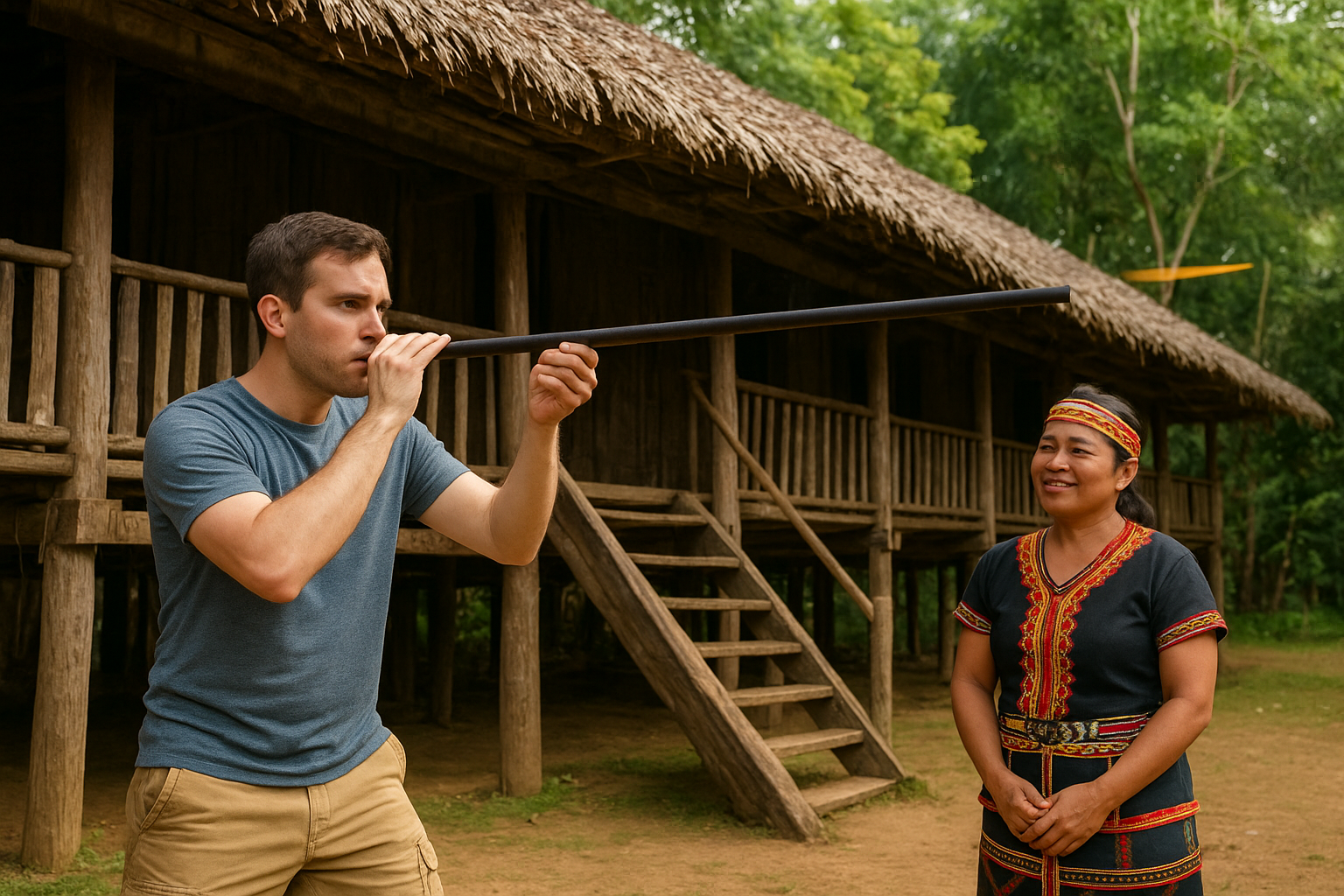
Mari Mari Cultural Village sits about 25 minutes north of Kota Kinabalu city center in the Inanam district and offers one of the most immersive cultural experiences in Sabah. The village recreates the traditional homes of five indigenous communities: the Kadazan-Dusun, Bajau, Murut, Lundayeh, and Rungus, with guided tours led by community members who demonstrate real practices, not performances.
Why it belongs on your first trip
Among the cultural things to do in Kota Kinabalu, Mari Mari stands apart because the experience is participatory, not passive. You enter working replicas of longhouses, watch blowpipe demonstrations, and sample traditional fermented rice wine called lihing during the tour. This builds a genuine understanding of Sabah's ethnic diversity in a way that museum exhibits alone can't replicate.
Pairing your Mari Mari visit with a morning stop at the Sabah State Museum gives you context that makes every part of the village tour more meaningful.
How to do it
Book your slot through Mari Mari Cultural Village's official booking channels since tours run on fixed schedules twice daily. The village operates guided group tours only, so independent entry is not available. Transport can usually be arranged through your hotel or the booking team.
Time and typical costs
Each tour lasts roughly three to three and a half hours. Adult admission costs approximately RM 150 per person, which covers the guided tour and a traditional meal at the end.
Tips for a smoother visit
Wear comfortable closed-toe shoes since parts of the village involve uneven terrain and steps into elevated longhouses. Book at least two days ahead during peak travel periods.
Best photo and content spots
The fire-starting and blowpipe demonstrations produce strong action shots in natural outdoor light. Position yourself at a slight angle rather than head-on to capture the demonstrator and the surrounding longhouse structure within the same frame.
16. Day trip to Kinabalu Park and Kundasang
Kinabalu Park sits roughly 90 kilometers east of Kota Kinabalu and holds Mount Kinabalu, the highest peak in Southeast Asia at 4,095 meters. Even if you have no plans to summit, the park's lower trails, botanical gardens, and cool mountain air make this one of the most rewarding things to do in Kota Kinabalu as a full-day escape from the city.
Why it belongs on your first trip
The landscape around Kinabalu Park looks and feels completely different from coastal KK. You're surrounded by montane rainforest, cloud cover rolling through tree canopies, and temperatures that drop noticeably compared to the coast. The nearby town of Kundasang adds a pastoral layer, with vegetable farms and war memorial gardens that give the trip additional weight.
Combining Kinabalu Park with a stop in Kundasang turns a standard mountain visit into a full cross-landscape day that covers everything from ancient forest to open highland farmland.
How to do it
Most visitors book a guided day tour from KK city that handles transport, park entry, and a Kundasang stop in a single package. You can also self-drive or hire a private car if you prefer flexibility.
Time and typical costs
The drive takes roughly two hours each way. Guided day tours typically cost between RM 120 and RM 200 per person, inclusive of transport and park fees.
Tips for a smoother visit
Bring a light jacket since temperatures in the park regularly drop below 20°C, especially at higher trail elevations.
Best photo and content spots
Shoot Mount Kinabalu's upper ridgeline from the Kundasang war memorial gardens in the early morning before clouds build around the peak.
Ready to plan your Kota Kinabalu trip
Kota Kinabalu packs a surprising range of experiences into a compact, easy-to-navigate city. From island hopping in Tunku Abdul Rahman Park to watching the sun drop over Tanjung Aru Beach, the things to do in Kota Kinabalu extend well beyond what most first-timers expect when they start planning.
The challenge is fitting it all together in a way that actually makes sense for your timeline. Rushing between highlights without a clear sequence means you lose time and miss the moments that make KK worth the trip. A well-built itinerary changes that entirely, turning a scattered list of stops into a trip you'll remember clearly.
If you want a plan built around your travel style and interests, let NextTrip.Travel build your KK itinerary. The concierge team handles the sequencing, bookings, and logistics so you show up ready to experience Kota Kinabalu, not manage it.