

Sabah sits on the northern tip of Borneo, where rainforests meet coral reefs and orangutans swing through ancient canopy. But timing your visit here matters more than most travelers realize. Choose the wrong month, and you could face washed-out dive sites, closed trails, or missed wildlife encounters. Understanding the best time to visit Sabah means knowing how its two monsoon seasons shape everything from water clarity at Sipadan to orangutan activity along the Kinabatangan River.
The short answer: Sabah is a year-round destination, but certain months give you a clear advantage depending on what you're after. Peak diving conditions, dry hiking weather, and prime wildlife spotting don't always overlap, so your ideal window depends on your priorities. Crowds and pricing shift with the seasons too, and budget-conscious travelers can find real value by timing things right.
At Nexttrip.Travel, we build itineraries around exactly these kinds of details, matching your travel goals with the right destination at the right moment. This guide breaks down Sabah's seasons month by month, covers the best windows for diving, trekking, and wildlife, and helps you decide when to book based on what matters most to you.
Why timing matters in Sabah
Sabah doesn't follow a simple "wet or dry" pattern the way some tropical destinations do. Two distinct monsoon systems move through the region at different times of year, and they hit different parts of Sabah in different ways. The east coast and the west coast often experience opposite conditions during the same month, which means that choosing where you're going inside Sabah is just as important as choosing when you arrive.
The northeast and southwest monsoons
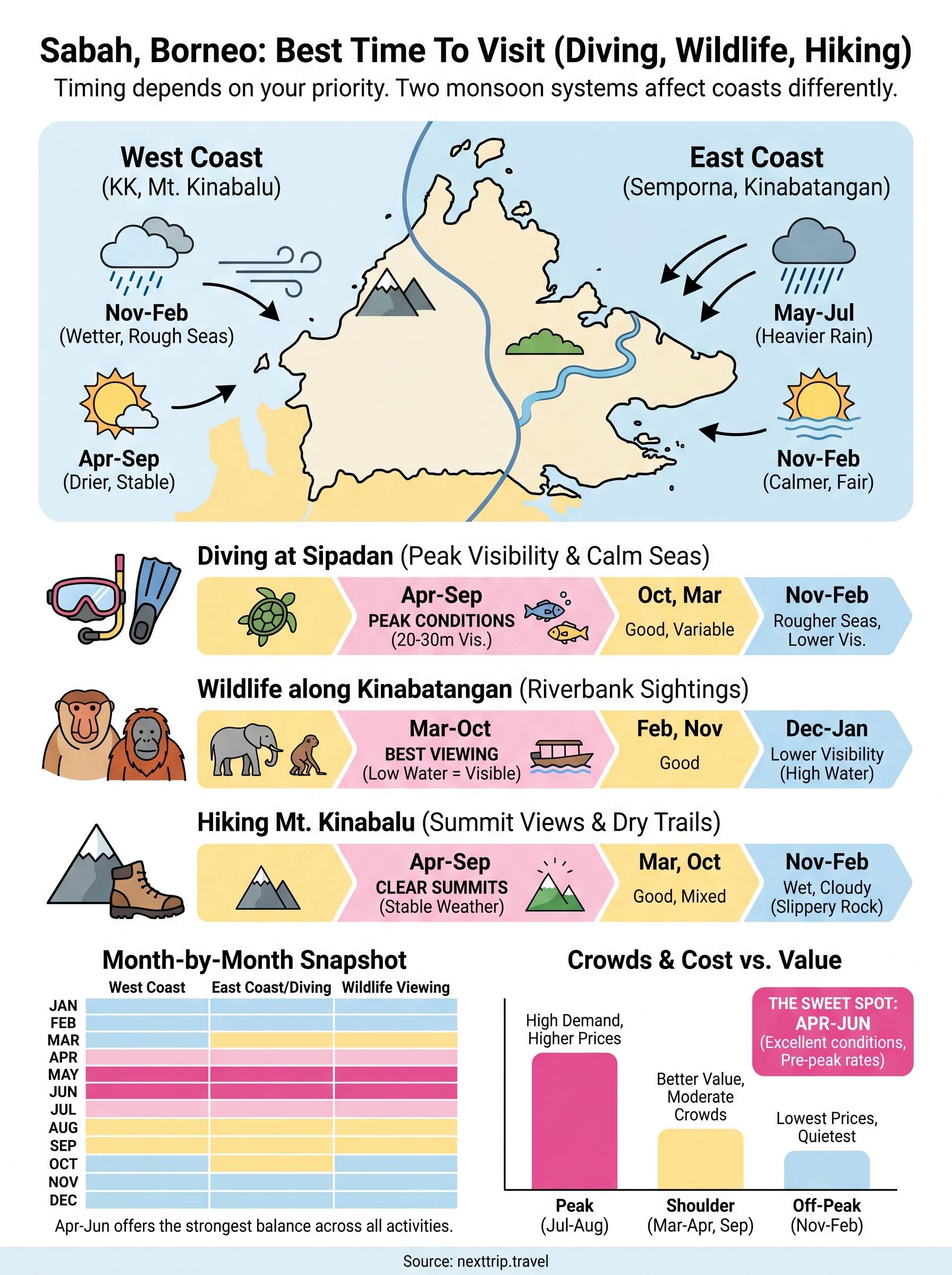
Sabah sits in the path of two monsoon systems that dominate opposite halves of the year. The northeast monsoon runs roughly from November through February and brings the heaviest rainfall and roughest seas to the west coast, including Kota Kinabalu. During these months, boat crossings to offshore island resorts become less predictable, and visibility at some dive sites drops significantly. The southwest monsoon, which runs from May through September, generally brings drier and more stable conditions to the west coast but can push unsettled weather toward the east coast and the Semporna archipelago in certain months.
Understanding which monsoon is active when you plan to travel is the single most useful step you can take before booking anything. If you're targeting a diving trip to Sipadan, you need different timing than someone planning to climb Mount Kinabalu or track proboscis monkeys along the Kinabatangan River. These are not small differences in comfort level. They affect whether tours run, whether trails are open, and whether underwater visibility is worth the flight.
The east coast of Sabah operates on a different weather calendar than the west coast, so a month that feels unsuitable for Kota Kinabalu can still be excellent for Semporna diving.
Why wildlife and water activities peak at different times
Sabah's appeal splits between two very different environments: rainforest wildlife and marine ecosystems. Each responds to the seasons in its own way, and that mismatch is where many travelers get caught out when they plan without checking the details.
Orangutans, pygmy elephants, and proboscis monkeys along the Kinabatangan River are most visible from March through October, when lower water levels push animals toward the riverbanks where you can actually spot them from a boat. Turtle nesting on Lankayan Island and the surrounding areas peaks between May and September. On the marine side, the best diving conditions at Sipadan arrive from April through September, when seas calm down and underwater visibility regularly reaches 30 meters or more. Whale sharks around Donsol and seasonal fish aggregations follow their own calendar too.
This split is central to picking the best time to visit Sabah based on your priorities. If your main goal is wildlife along the Kinabatangan, March through May offers a strong window where dry conditions and solid early-season diving overlap without the full peak-season crowds. If diving is the primary reason you're making the trip, April through June gives you reliable conditions across Sabah's top marine sites before the July and August crowd surge drives up accommodation prices. Knowing your core activity in advance lets you build your travel window around what actually matters to you, rather than chasing an all-around "perfect" month that does not really exist in a destination this varied.
Sabah weather basics and regional differences
Sabah sits close to the equator, which means it stays warm and humid year-round, with temperatures hovering between 23°C and 33°C regardless of season. What changes dramatically is rainfall, sea conditions, and cloud cover. Two monsoon systems take turns shaping those conditions, and they do not affect every part of Sabah equally. Before you can confidently pick the best time to visit Sabah, you need to understand how the region splits geographically.
West coast: wetter winters, drier summers
The west coast, which includes Kota Kinabalu, Kota Belud, and Mount Kinabalu, bears the brunt of the northeast monsoon between November and February. During these months, rainfall increases, skies cloud over more consistently, and boat transfers to nearby island resorts like Manukan or Sapi become less reliable. The trails on Mount Kinabalu stay open year-round but wet conditions from November through January make rock surfaces slippery and summit views rare. If you are planning to climb or spend time on the west coast, the April through September window gives you far more stable conditions, with May through July being the sweet spot for clear mornings and manageable humidity.
The dry season on Sabah's west coast does not mean zero rain. Afternoon showers still happen, but they pass quickly and rarely cancel outdoor plans.
East coast: a different weather calendar
The east coast operates on a nearly opposite schedule. Areas like Semporna, Sandakan, and the Kinabatangan River corridor tend to see their heaviest rainfall from May through July, while the northeast monsoon months that disrupt the west coast are actually among the calmer periods for the east. This regional split means that a month written off as "rainy season" for one part of Sabah can still offer excellent diving visibility or smooth river conditions on the opposite coast. When you plan your Sabah itinerary, map your activities to the correct coast first, then check the corresponding seasonal calendar. Treating Sabah as a single weather zone is the most common planning mistake travelers make before their first visit.
Best time for key activities in Sabah
Knowing the best time to visit Sabah matters most when you anchor your trip around a specific activity. Sabah's top experiences, from world-class diving to rainforest wildlife tracking, each have a seasonal window where conditions stack in your favor. Picking the right window for your primary goal is what separates a trip that delivers on its promise from one that falls short.
Diving at Sipadan and Semporna
Sipadan Island consistently ranks among the best dive sites in Southeast Asia, and the conditions that make it exceptional are highly seasonal. April through September gives you the most reliable visibility, with calm seas and water clarity regularly hitting 20 to 30 meters. Hammerheads, barracuda tornadoes, and sea turtles are most consistently spotted during this period. Outside this window, particularly from November through January, rougher seas can complicate boat transfers from Semporna to the dive sites and reduce visibility underwater.

The number of daily dive permits for Sipadan is capped at 120, so you need to book your spot well in advance regardless of when you travel.
Your operator will handle the permit logistics, but timing your visit between May and August gives you both the best conditions and the highest chance permits are available through established resorts.
Wildlife along the Kinabatangan River
The Kinabatangan River corridor in eastern Sabah is one of the most accessible places on earth to spot wildlife in a wild setting, including pygmy elephants, proboscis monkeys, and wild orangutans. The best viewing period runs from March through October, when lower water levels push animals toward the riverbanks. During wetter months, animals move deeper into the forest and boat-based spotting becomes far less productive.
March, April, and October offer the best balance: wildlife visibility is strong, humidity is slightly lower than peak dry season, and you avoid the July and August surge in tour bookings.
Climbing Mount Kinabalu
Summit attempts on Mount Kinabalu are most rewarding between April and September, when skies clear enough to actually see the view from Low's Peak at 4,095 meters. The trail stays open year-round, but wet rock and persistent cloud cover from November through January make the climb more challenging and the summit experience far less satisfying. If a clear summit view is part of your goal, plan your ascent between May and July for the most consistent morning conditions.
Sabah month-by-month planner
Using a month-by-month view gives you an instant snapshot of what each travel window offers and where the trade-offs sit. The table below maps out conditions by month across Sabah's primary activities, so you can lock in your dates around what matters most to your trip.
| Month | West Coast | East Coast / Diving | Wildlife Viewing | Overall |
|---|---|---|---|---|
| January | Wet, rough seas | Calmer, fair visibility | Moderate | Low |
| February | Wet, improving | Fair | Moderate | Low-Moderate |
| March | Improving | Good | Strong | Moderate |
| April | Dry, clear | Excellent | Strong | High |
| May | Dry, clear | Excellent | Strong | High |
| June | Dry, clear | Excellent | Good | High |
| July | Dry | Very good | Good | High (busy) |
| August | Dry | Very good | Good | High (busy) |
| September | Dry, late showers | Good | Strong | Moderate-High |
| October | Mixed | Moderate | Strong | Moderate |
| November | Wet | Rougher | Moderate | Low-Moderate |
| December | Wet | Rough | Lower | Low |
The strongest months for most travelers
April through June consistently delivers the best balance across Sabah's main draws. The west coast sits in its dry window, Sipadan diving conditions are at their peak, and the Kinabatangan River offers strong wildlife visibility before July crowds push up pricing. If you want the best time to visit Sabah across the widest range of activities without fighting peak-season demand, this three-month block is your clearest answer.
April is particularly strong because it sits at the intersection of good diving, reliable wildlife sightings, and pre-peak accommodation rates.
The months worth approaching with a plan
November through January requires the most careful planning. The northeast monsoon pushes unsettled weather across the west coast, and boat transfers to offshore islands can be disrupted on short notice. That said, these months are not a write-off. East coast sites like Semporna stay relatively workable, and lower tourist numbers translate directly into better accommodation rates and quieter river cruises. If your itinerary centers on the east coast, a well-planned trip with a knowledgeable local operator can still deliver a strong experience during these quieter months.
Crowds, prices, and events to consider
Crowd levels and accommodation rates in Sabah track closely with weather patterns, which means the best time to visit Sabah for your wallet is not always the same as the best time for conditions. Understanding when demand spikes and when it drops gives you a real advantage when you are comparing flight prices, booking dive permits, or locking in a river lodge along the Kinabatangan.
Peak season pricing and availability
July and August represent the busiest travel period in Sabah. School holidays across Malaysia, Singapore, and much of Europe push demand sharply upward during these two months, and accommodation rates at top-tier properties in Kota Kinabalu, Semporna, and the Kinabatangan corridor can increase by 20 to 40 percent compared to the shoulder months on either side. Sipadan dive permits, which are already capped at 120 per day, become significantly harder to secure through your preferred resort during this peak window. Book at least three to four months ahead if July or August is non-negotiable for your schedule.
Traveling in April or May gives you nearly identical diving and wildlife conditions to peak season, often at noticeably lower rates and with more flexibility on bookings.
Shoulder months like March, April, and September hit a strong balance between favorable weather and manageable crowd levels. Prices at most resorts sit closer to off-peak rates, and popular sites like the Sepilok Orangutan Rehabilitation Centre draw smaller daily visitor numbers. If your schedule has any flexibility at all, shifting your trip into one of these months is a straightforward way to get more value without sacrificing the quality of your experience.
Festivals and local events worth planning around
Sabah Fest, typically held in May, brings together cultural performances, traditional crafts, and indigenous music from across the state's 32 ethnic groups. It runs in Kota Kinabalu and draws visitors from across Malaysia. Pesta Keamatan, Sabah's harvest festival celebrated throughout May, adds a distinct local energy to the west coast during what is already one of the strongest travel months on the calendar. Timing your visit to overlap with either event adds a layer to your trip that standard itineraries rarely capture.
Ready to choose your Sabah travel window
The best time to visit Sabah depends entirely on what you want to do while you are there. If diving is your priority, April through June gives you the strongest conditions at Sipadan without the July and August crowd surge. If wildlife along the Kinabatangan River drives your decision, March through May or September through October puts you on the water when animal sightings are most reliable and tour groups are thinner.
Your trip improves significantly when you match your activity goals to the right seasonal window rather than simply booking around school holidays or a convenient flight deal. Timing and itinerary design work together, and getting both right from the start is what separates a good Sabah trip from a great one. When you are ready to plan a trip built around your actual priorities, explore curated Sabah itineraries with Nexttrip.Travel and let an expert put the details together for you.