

You've been thinking about it for a while, that trip you want to take, on your own terms, at your own pace. But figuring out how to plan a solo trip for the first time can feel overwhelming when you're staring at a blank itinerary with no one to split decisions with. The good news? It's more straightforward than it seems, and thousands of first-time solo travelers pull it off every single day.
Solo travel strips away the compromises. You eat where you want, stay as long as you like, and change plans on a whim. But that freedom only feels good when you've handled the practical stuff first, budgeting, safety, logistics, and building a realistic itinerary that actually works. Skip those steps, and the freedom turns into stress fast.
At Nexttrip.Travel, we help travelers design personalized journeys tailored to their style, including solo explorers who want expert concierge planning without the cookie-cutter packages. Whether you book through us or handle everything yourself, this guide walks you through each stage of planning your first solo trip, from choosing a destination and setting a budget to staying safe and actually enjoying your own company on the road.
What to decide before you book anything
Before you open a single booking site, there are a few foundational decisions that will shape everything else. Most first-time solo travelers skip this stage and jump straight to searching for flights, which leads to confusion, overspending, and itineraries that don't match what they actually want. Spending 30 minutes on these decisions upfront saves you hours of backtracking later, and it's what separates a chaotic first trip from a smooth one.
Know your travel style and comfort level
Solo travel looks different for everyone. Some people want full independence, booking nothing in advance and figuring it out as they go. Others need structure and confirmed reservations to feel at ease. Neither approach is wrong, but you need to be honest with yourself before you commit to a destination or a style of trip. A spontaneous backpacking route through Southeast Asia is a very different planning challenge than a structured week in Japan with pre-booked hotels and train passes.
Ask yourself a few direct questions before you start planning: Do you get anxious without a plan, or do rigid schedules drain you? Are you comfortable navigating public transport in a city where you don't speak the language? Your answers here will determine how detailed your itinerary needs to be and which destinations are a realistic fit for your first solo trip.
Your travel style isn't fixed, but for your first solo trip, starting within your comfort zone gives you a better shot at actually enjoying it rather than white-knuckling through it.
Set your non-negotiables
Non-negotiables are the things you refuse to compromise on, and writing them down prevents you from booking something that looks good on screen but makes you miserable in practice. This might mean a private room every night, a hard return date, or avoiding overnight buses on your own. It might also mean making sure you have reliable internet access each day if you work remotely or need to stay in touch with family.
Use this simple template before you search for anything:
My solo trip non-negotiables:
- Budget ceiling per day: $___
- Accommodation type: (private room / dorm / flexible)
- Maximum travel time per leg I'm comfortable with: ___ hours
- Regions or countries I'm not ready to visit solo yet: ___
- Daily must-have access: (local SIM / Wi-Fi / neither)
- Hard return date: ___
Filling this in honestly takes five minutes and acts as a filter for every decision that follows.
Decide how much help you want with planning
One decision that doesn't get enough attention when people research how to plan a solo trip is how much of the logistics they actually want to handle themselves. Planning everything independently gives you maximum control, but it also takes real time and research, especially for a first-time traveler who doesn't yet know which sources to trust. Using a concierge travel service for parts of your trip, like transfers, accommodation, or activity bookings, is a practical choice that lets you focus on the experience rather than the admin.
Think about where your time and energy are best spent. If you enjoy researching hotels and comparing transport routes, do it yourself. If that part feels like a chore that's stopping you from actually committing to the trip, delegate what you can and put your energy into the parts of planning you find genuinely exciting. Knowing this upfront helps you decide early on whether you're building your trip from scratch or working with a travel expert who can handle the heavy lifting.
Step 1. Pick a destination, dates, and budget
These three decisions feed into each other, so tackling them together saves you from booking flights to a destination you can't afford for the dates you have available. The clearest way to approach this step is to start with your destination, let that inform your likely daily costs, then check those costs against your available dates and total trip budget before committing to anything.
Choose a destination that matches your experience level
First-time solo travelers do better in destinations with reliable infrastructure, English-friendly signage, and straightforward transportation systems. That doesn't mean you're limited to tourist traps. Countries like Japan, Portugal, Thailand, and New Zealand consistently work well for solo safety, ease of navigation, and strong traveler communities where you'll find company if you want it.
Narrow your shortlist by asking two questions: Can you navigate this city without speaking the local language, and does this destination match the travel style you identified before booking anything? If both answers are yes, it earns a place on your working list.
Pick a destination that excites you enough to push through the nerves, but is realistic enough that logistics don't eat the whole experience.
Build a budget you can actually stick to
Knowing how to plan a solo trip means knowing your numbers before your flights are confirmed. Use this daily budget template as your starting point:

| Expense category | Budget range per day |
|---|---|
| Accommodation (private room) | $25 - $120 |
| Food (local restaurants) | $10 - $40 |
| Local transport | $5 - $20 |
| Activities and entrance fees | $10 - $50 |
| Emergency buffer | $15 - $30 |
Multiply your daily total by your number of trip days, then add flights and any pre-booked tours to get your full trip cost. If the number is too high, shorten the trip or adjust the destination before you book anything.
Lock in your travel dates
Check public holidays, school breaks, and peak seasons for your chosen destination before you commit to dates. Prices in popular spots like Bali or Barcelona can spike sharply during peak periods, and crowds change the experience entirely. Use your return date as a fixed anchor and work backwards to set your departure, giving yourself at least one buffer day on each end to absorb travel delays without stress.
Step 2. Build a simple itinerary that fits you
A common mistake first-time solo travelers make is trying to pack too much into every single day. When you're working out how to plan a solo trip, the goal is an itinerary that keeps you moving without burning you out by day three. A realistic daily plan balances anchor activities with enough breathing room so you can follow unexpected moments when they show up, which is exactly what makes solo travel worth doing.
Use two or three anchor activities per day
Anchor activities are the non-negotiable highlights you want to hit on a given day: a museum visit, a specific market, a booked tour. Limit yourself to two or three per day maximum, and treat everything else as optional. This structure gives your day direction without turning it into a checklist you're racing through from the moment you wake up.
Use this daily itinerary template as your starting point:
Day [X] - [City/Area]
- Morning anchor: [Activity + rough start time]
- Afternoon anchor: [Activity + rough start time]
- Evening option: [Restaurant, neighborhood, or rest - your call]
- Transport notes: [How you're getting between points]
- Backup plan: [One alternative if closures or weather change things]
Fill this in for each day before you arrive, but keep the backup plan column honest. Knowing one solid alternative for each anchor activity means a closed attraction or a rainy afternoon doesn't collapse the whole day. Two minutes of backup planning per activity removes most of the stress that catches first-time solo travelers off guard.
Protect at least one full free day per week
Rigid itineraries are the fastest way to turn solo travel from freeing into exhausting.
One completely unplanned day per week lets you revisit something you loved, sleep in, or follow a local recommendation you picked up the night before. Solo travel gives you this flexibility by design, but you have to schedule the space deliberately or other bookings fill it before you even land.
If your trip runs five days or fewer, protect at least one half-day with nothing locked in. Use the time to walk without a destination, try a restaurant you spotted on day one, or simply recharge. The second half of any trip feels noticeably better when you've given yourself that recovery window rather than burning through every hour.
Step 3. Book transportation, stays, and key tickets
Once your itinerary is in place, it's time to convert your plan into confirmed reservations. The order you book in matters more than most guides acknowledge. When you understand how to plan a solo trip at this stage, you follow a clear booking sequence: flights first, then accommodation, then activity tickets that have limited availability or specific time slots.
Book your transport in the right order
Lock in your flights before anything else, since your accommodation options and costs shift based on when you arrive and depart. For in-country transport, research your options before committing to a single method. Train networks in countries like Japan and Portugal reward advance booking with lower fares, while bus routes in Southeast Asia are often best booked one to three days ahead rather than weeks out.
Use this booking order as your checklist:
- International flights (book 6-10 weeks out for best pricing on popular routes)
- Airport-to-accommodation transfer for arrival day
- Inter-city trains or buses between your main stops
- Return airport transfer for departure day
Booking your arrival transfer in advance is the one logistics step that reduces first-night solo travel stress more than anything else.
Choose accommodation that fits solo travel
Solo travelers pay a single-occupancy rate, which means accommodation often takes a larger share of your budget than it would for a pair. Narrow your options by filtering for guest reviews that specifically mention safety, solo-friendly atmosphere, and responsive staff. Hostels with private rooms give you budget pricing with social common areas if you want company. Mid-range hotels with 24-hour reception work well if you value quiet and privacy.
Before you book each stay, confirm these four details:
- Check-in process: is there a manned reception or a self-check-in kiosk?
- Location: is it walkable from a main transit stop at night?
- Cancellation policy: free cancellation up to 48 hours before arrival is the standard you want
- Storage: does it offer luggage storage on check-out day?
Pre-book only the tickets that need it
Not every attraction requires advance booking, but skipping pre-booking on high-demand sites costs you real time in queues or, worse, a sold-out day. Research each anchor activity on your itinerary and identify which ones have timed entry or capped daily visitors. Popular museums, national parks with entry quotas, and guided tours in peak season all fall into this category. Book those and leave everything else flexible.
Step 4. Plan for safety, backups, and confidence
Safety planning is the part of how to plan a solo trip that most guides either skip entirely or bury in generic advice about "staying aware." The reality is that most safety preparation takes less than an hour and covers 90% of the situations that catch solo travelers off guard. Do it before you leave, not after you land.
Build your safety document
Every solo traveler needs a single document with the key information someone would need if you were unreachable. Store it in your email drafts, your phone, and a printed copy in your bag. This isn't worst-case thinking, it's a practical habit that experienced solo travelers treat the same way they treat packing their passport.
Use this template as your safety document:
Solo Trip Safety Reference
- Full name and passport number: ___
- Trip dates and destination cities: ___
- Flight numbers and booking references: ___
- Accommodation name, address, and check-in phone number for each stay: ___
- Emergency contact at home (name and number): ___
- Local emergency number for each country visited: ___
- Travel insurance policy number and 24-hour claims line: ___
- Nearest embassy or consulate address: ___
Share this document with one trusted person at home before you depart, and update it if your plans change mid-trip.
Handle the unexpected before it happens
Your backup plan for logistics works the same way your itinerary backup did in Step 2: you identify the most likely disruptions and write down your response before they happen. A delayed flight, a lost bank card, and a sold-out transfer are the three most common problems first-time solo travelers face, and all three have straightforward solutions if you've prepared for them.
Before you leave, confirm these three backups:
- Carry two payment methods in separate locations, one in your wallet and one in your bag
- Save offline maps for every city on your itinerary using Google Maps so navigation works without data
- Write the address of your first accommodation on a physical card you can hand to a taxi driver if your phone dies on arrival
Confidence in solo travel doesn't come from being fearless. It comes from knowing you've already solved the problems most likely to go wrong.
Build confidence through small actions
Your confidence grows in direct proportion to the decisions you make on your own, even small ones. On your first day, navigate one journey by public transport instead of taking a taxi. Order something from a menu you don't fully understand. Each small act of independent decision-making builds the mental baseline that makes every subsequent day feel easier and more natural.
If nerves hit hard before you leave, reframe the feeling as practical. Make a short list of three specific things you're uncertain about, then research each one until you have a concrete answer. Uncertainty shrinks when you replace it with actual information, and arriving with answers already in hand is one of the fastest ways to shift from anxious to ready.
Your solo trip plan, finalized
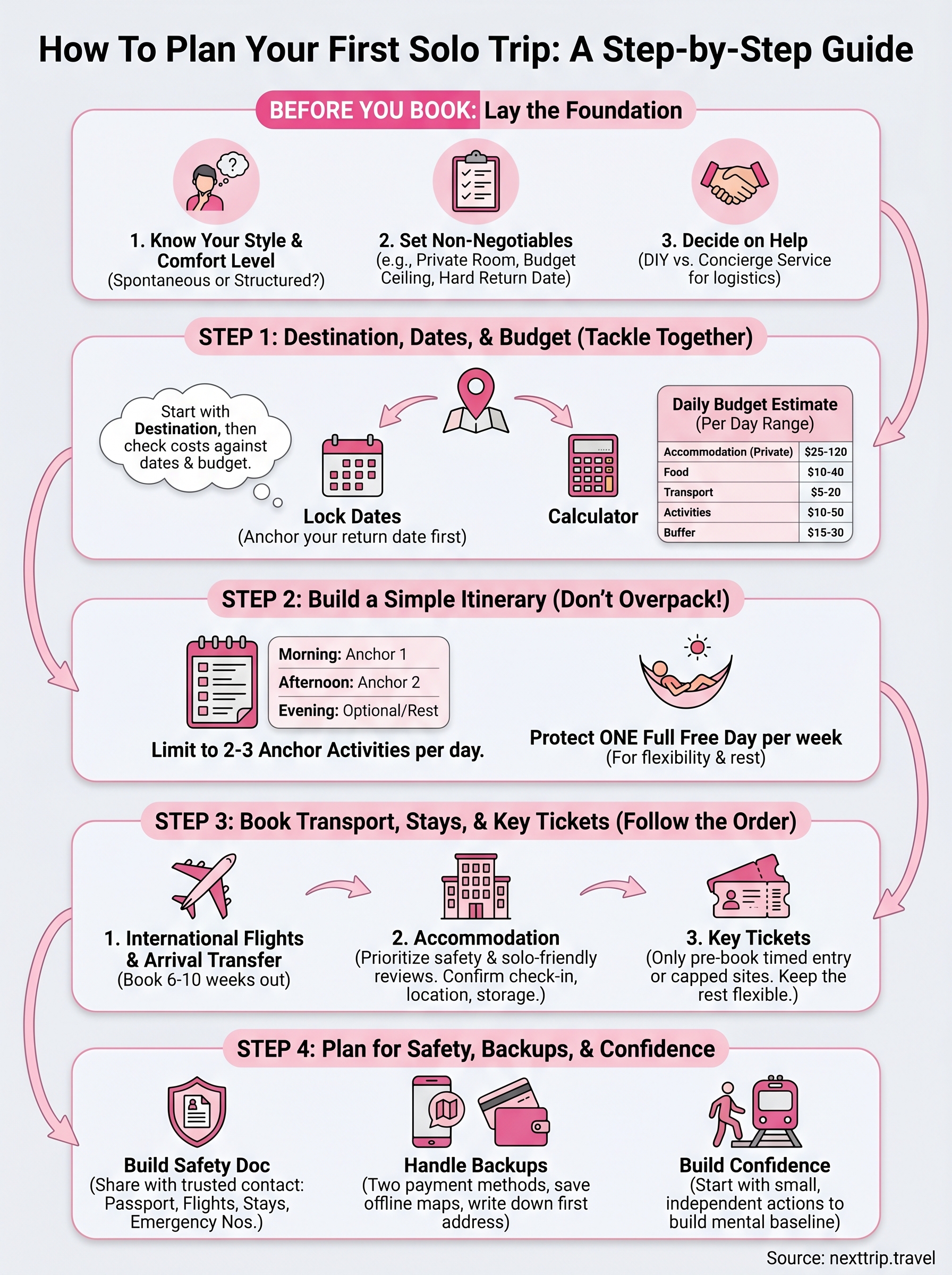
You now have every building block you need. Knowing how to plan a solo trip comes down to making decisions in the right order: clarify your travel style, pick a realistic destination, set a budget that holds, build an itinerary with breathing room, book in sequence, and handle safety before you pack. None of these steps require expert-level experience, just honest answers to straightforward questions and the willingness to commit.
The most important move now is to start. Pick one decision from this guide, your destination shortlist, your daily budget number, your non-negotiables, and make it concrete today. Momentum builds fast once the first decision is locked in, and the rest of the planning follows naturally from there.
If you want expert help designing a solo itinerary that fits your style without the hours of research, explore curated solo travel experiences at Nexttrip.Travel and let a concierge planner handle the heavy lifting.