

If you've been searching for what to do in Sabah, Malaysia, you're about to discover one of Southeast Asia's most rewarding destinations. Sitting on the northern tip of Borneo, Sabah delivers the kind of raw, unfiltered experiences, from jungle-covered peaks to coral-rich coastlines, that most places can only promise.
This isn't a state you visit to check a box. It's where you climb Southeast Asia's tallest mountain before sunrise, lock eyes with a wild orangutan, and drift over reefs that rival anything in the Maldives. Every day here fills up fast, and that's exactly the problem most travelers face: narrowing down what to prioritize with limited time on the ground.
That's why we built this guide at Nexttrip.Travel, drawing from real, on-the-ground experience and curated travel insights to help you plan a Sabah itinerary worth every hour. Below, you'll find 11 must-do experiences covering nature, wildlife, culture, and adventure, organized so you can start building your trip right now.
1. Plan an insider itinerary with Nexttrip.Travel
Figuring out what to do in Sabah, Malaysia without local knowledge costs you real time and money. Nexttrip.Travel fixes that problem by connecting you with curated, influencer-informed itineraries built by travelers who have actually walked these routes, stayed at these lodges, and know which stops are worth the detour.
What you'll do
With Nexttrip.Travel, you can browse pre-built Sabah itineraries or work directly with a concierge team to design a custom route. Options range from a 5-day wildlife and coastline combination to multi-week immersions into Borneo's interior rainforest and river systems. The platform handles everything from transport to accommodation and activity booking under one roof.
Why it's worth it
Generic travel packages skip the places that matter most. Nexttrip.Travel itineraries pull from real traveler experience and local insider knowledge, putting overlooked river lodges and genuine wildlife encounters on your radar instead of the standard tourist circuit. You leave with a trip that's harder to replicate through off-the-shelf booking sites.
The difference between a forgettable trip and one you talk about for years usually comes down to knowing exactly which spots to prioritize and in what order.
How to plan it
Head to nexttrip.travel, browse the Sabah experience categories, and either select a pre-built itinerary or submit your travel dates and preferences to the concierge team. You receive a fully mapped, day-by-day route with accommodation, transport, and activity recommendations organized in one place so nothing falls through the cracks before departure.
Cost, timing, and tips
Pricing scales with trip length and experience level, from budget-focused nature routes to high-end resort and wildlife combinations. Book at least 6 to 8 weeks ahead if your trip includes Sipadan diving permits or Mount Kinabalu climbing slots, as both operate under strict daily limits that fill up fast.
- Sipadan Island: diving permits capped at 120 per day
- Mount Kinabalu: climbing permits sell out months in advance
- Kinabatangan lodges: book early during peak dry season
Best time to go
March through October covers Sabah's main dry season and delivers the best conditions for climbing, diving, and river wildlife spotting. Kinabatangan River sightings peak during these months as animals concentrate near the water, making any cruise booked through this window especially productive.
2. Start in Kota Kinabalu with food and waterfront
Most travelers planning what to do in Sabah, Malaysia land in Kota Kinabalu (KK) first, and that's a genuine advantage. The city pulls double duty as both a practical base and a destination worth exploring on its own terms.
What you'll do
Your first move in KK should be the Gaya Street Sunday Market, where local vendors sell fresh produce, handcrafted goods, and street food that reflects Sabah's mixed ethnic heritage. From there, walk the waterfront esplanade along Jalan Tun Fuad Stephens for sunset views over the South China Sea and the islands of Tunku Abdul Rahman Marine Park sitting just offshore.
Why it's worth it
KK rewards travelers who spend more than a transit night here. Signal Hill Observatory gives you a full panorama of the city and coastline, and the Filipino Market near the waterfront serves fresh grilled seafood at prices that won't push your budget.
First impressions set the tone for a trip, and KK's combination of ocean views and open-air night markets delivers one of Borneo's most accessible and satisfying entry points.
How to plan it
Stay within the city center area to keep everything walkable. Most markets, restaurants, and departure points for island and jungle trips sit within a short distance of the main hotels.
Cost, timing, and tips
Budget around MYR 50 to MYR 150 per day for food and local transport. The Gaya Street Market runs Sunday mornings only, so time your arrival accordingly.
Best time to go
April through September gives you the most consistent dry weather for waterfront evenings and outdoor dining.
3. Island hop in Tunku Abdul Rahman Marine Park
Tunku Abdul Rahman Marine Park sits just minutes from Kota Kinabalu's waterfront and covers five islands, each offering a distinct reason to visit. This is one of the most accessible stops when planning what to do in Sabah, Malaysia, and it fits neatly into a single day without any long-haul travel.
What you'll do
You take a short boat ride from Jesselton Point Ferry Terminal to islands like Manukan, Sapi, and Mamutik, where you can snorkel directly off the beach, kayak through clear shallows, or simply swim in calm, warm water. Sapi Island draws visitors with its snorkeling trails and wildlife, including monitor lizards that wander the shoreline without much concern for tourists.
Why it's worth it
Few marine parks give you coral reefs and beach time this close to a major city. The water clarity around Manukan and Mamutik supports healthy reef fish populations, making snorkeling productive even for beginners.
Spending a morning here before heading inland adds a contrast to your trip that no jungle itinerary can replicate.
How to plan it
Book your boat transfer and snorkel gear rental directly at Jesselton Point Terminal. Most operators run boats throughout the morning, so an early departure gives you the best light and fewer crowds on the beach.
Cost, timing, and tips
Budget around MYR 40 to MYR 80 per person covering the boat and basic gear rental. Arrive by 8:00 AM to beat day-trippers from the city center.
Best time to go
April through August delivers the calmest sea conditions and the best underwater visibility across the park.
4. Climb Mount Kinabalu
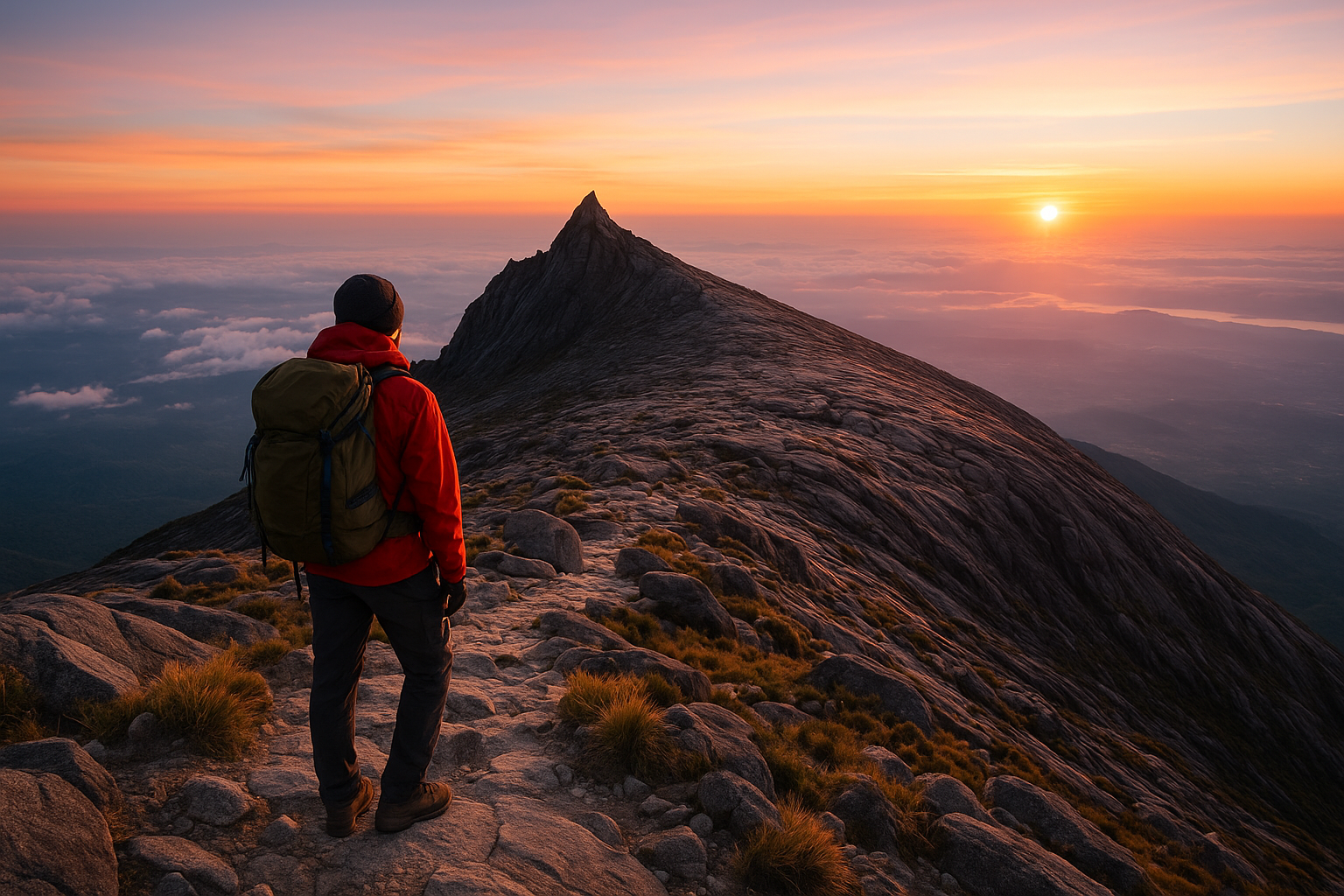
At 4,095 meters, Mount Kinabalu is the highest peak in Southeast Asia and one of the clearest answers to what to do in Sabah, Malaysia if you want an adventure that tests your limits. The climb takes you through distinct vegetation zones before delivering a summit sunrise that earns its reputation on every clear morning.
What you'll do
You start the ascent at Timpohon Gate around 7:00 AM, hiking through cloud forest and exposed granite toward Laban Rata Resthouse at 3,272 meters, where you sleep before the summit push. The final stretch to Low's Peak begins around 2:00 AM, timed to reach the top at first light.
Why it's worth it
The summit view stretches across northern Borneo's rainforest and coastline on clear days, rewarding every hour of effort. Few climbs worldwide combine this level of accessibility with genuine mountain drama in a single overnight trip.
Standing on Low's Peak at sunrise, with Borneo spread out beneath you, is the kind of moment that reframes what adventure travel actually means.
How to plan it
Book your climbing permit and Laban Rata accommodation directly through Sabah Parks well ahead of your trip. Daily quotas cap the number of climbers strictly, and peak-season slots disappear months in advance.
Cost, timing, and tips
Expect to pay around MYR 1,000 to MYR 1,500 per person, which covers your permit, mandatory guide fee, and overnight lodging at Laban Rata.
Best time to go
March through September offers the driest windows and the best chance of a clear summit view at dawn.
5. Explore Kinabalu Park and Kundasang
Kinabalu Park sits at the base of the mountain and earns a full day of exploration entirely on its own, separate from the climb. The park holds one of the world's most biodiverse ecosystems, including over 5,000 plant species, pitcher plants, and orchids found nowhere else on Earth. For anyone planning what to do in Sabah, Malaysia, this UNESCO World Heritage Site deserves serious attention.
What you'll do
You walk the botanical garden trails at the park headquarters, which take you through labeled collections of native flora at a relaxed pace. Afterwards, the short drive to Kundasang opens up market stalls selling fresh highland vegetables, strawberries, and local dairy products against a dramatic mountain backdrop.
Why it's worth it
The park delivers a completely different experience from the coast or river systems, putting highland Borneo's plant diversity directly in front of you without requiring a strenuous hike.
Kundasang's cool air and open farmland offer one of the most visually distinct contrasts you'll find anywhere along Sabah's interior route.
How to plan it
Combine both stops in a single day by arriving at park headquarters early and driving to Kundasang by midday. Most guesthouses in the area can arrange transport.
Cost, timing, and tips
Park entry runs around MYR 15 to MYR 25 per person. Budget 2 to 3 hours for the garden trails before heading to the market.
Best time to go
March through October keeps the highland trails clear and the mountain views sharp from Kundasang's viewpoints.
6. Unwind at Poring Hot Springs and canopy walk
Poring Hot Springs sits within Kinabalu Park and offers one of the most satisfying wind-downs after a strenuous mountain climb. The combination of natural thermal pools and an elevated canopy walkway makes this stop worth building into any itinerary focused on what to do in Sabah, Malaysia.
What you'll do
You soak in open-air sulfuric hot spring baths set against dense jungle, then walk a suspended canopy bridge that stretches through the upper tree canopy above the forest floor. The walkway sits roughly 40 meters high in places, putting you at eye level with the forest's upper layer where birds and insects are most active.
Why it's worth it
Most travelers visit Poring directly after descending Mount Kinabalu, and the hot springs do exactly what your body needs at that point. Aching legs recover fast in the thermal water, and the canopy walk adds an entirely different perspective on Borneo's jungle that ground-level trails simply cannot replicate.
Few experiences transition as naturally as going from a mountain summit straight into a jungle canopy with a hot soak in between.
How to plan it
Arrange transport from Kinabalu Park headquarters to Poring through your lodge or a local driver. The two stops sit close enough to combine in a single day without rushing either one.
Cost, timing, and tips
Entry and hot spring access runs around MYR 15 to MYR 30 per person. Arrive before noon to get the pools before afternoon tour groups arrive.
Best time to go
March through October keeps the canopy walk open and the surrounding trails dry enough to explore comfortably after your soak.
7. Visit Sepilok orangutans and sun bears
Sepilok sits near Sandakan on Sabah's east coast and holds two of the most compelling wildlife encounters you can have anywhere in Borneo. For anyone thinking through what to do in Sabah, Malaysia, this is a stop that consistently exceeds expectations.
What you'll do
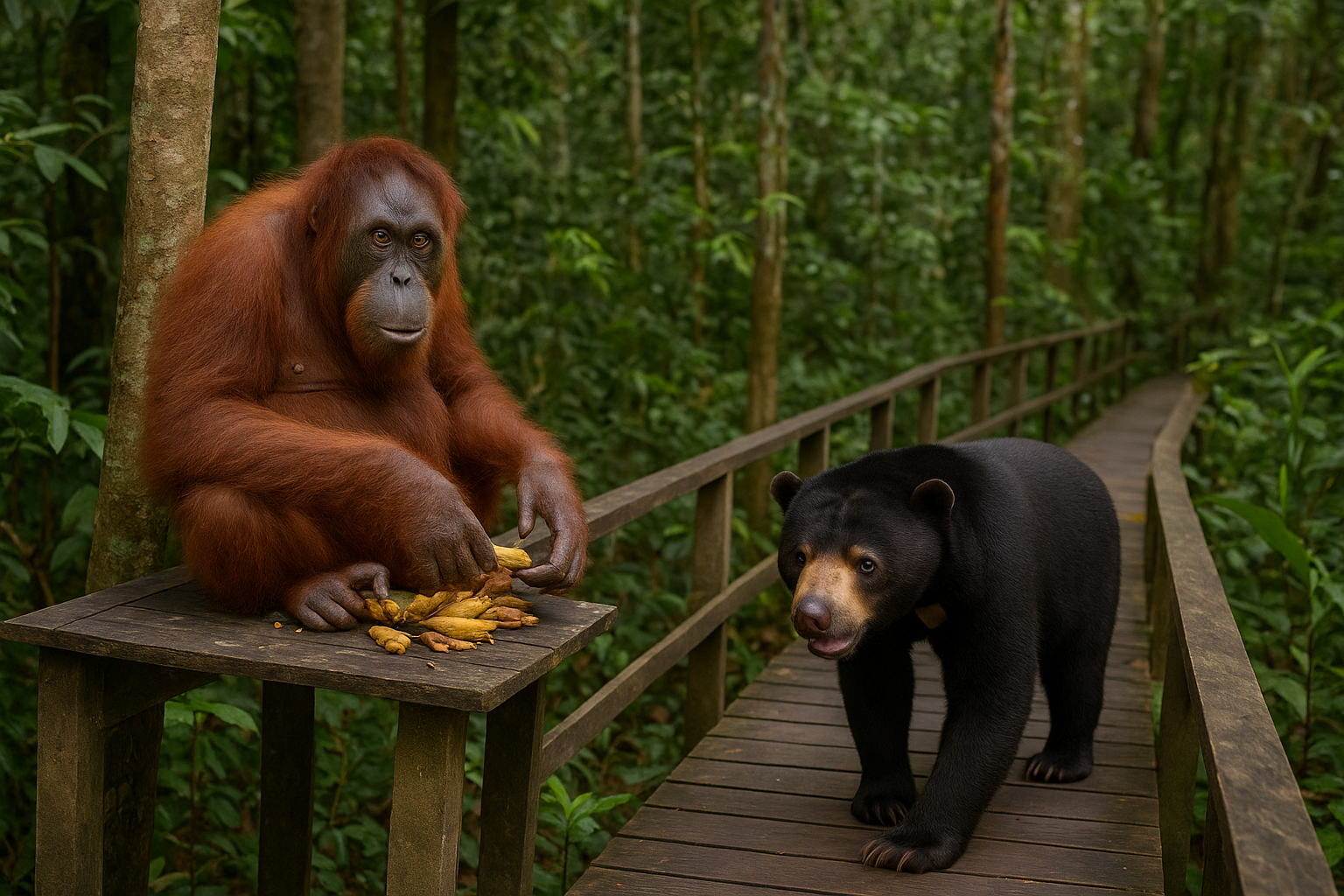
At the Sepilok Orangutan Rehabilitation Centre, you watch semi-wild orangutans arrive at feeding platforms twice daily, moving through the trees with the kind of unhurried confidence that makes it clear these animals belong here. Directly next door, the Bornean Sun Bear Conservation Centre introduces you to the world's smallest bear species at close range along raised boardwalks that put you just meters from the enclosures.
Why it's worth it
Both centres run serious conservation programs, not tourist shows. The orangutans are rehabilitated rescues being prepared for full forest release, and every visit contributes directly to that effort. Watching a young orangutan navigate the forest canopy on its own terms is a genuinely different experience from zoo wildlife.
Few wildlife encounters hit as personally as watching an orangutan look back at you with the same curiosity you're directing at it.
How to plan it
Both centres sit within walking distance of each other, so you can cover both in a single half-day. Book your visit slot through each centre's official website ahead of time to confirm feeding session times.
Cost, timing, and tips
Entry runs around MYR 30 to MYR 80 per centre. Arrive for the 10:00 AM feeding session to maximize sighting time before midday heat slows animal activity.
Best time to go
March through October gives you dry conditions and more active wildlife across both centres.
8. Cruise the Kinabatangan River for wildlife
The Kinabatangan River runs through the heart of Sabah's eastern rainforest and delivers some of the most concentrated wildlife viewing in all of Southeast Asia. If you're still weighing what to do in Sabah, Malaysia, this river cruise belongs near the top of your list.
What you'll do
You board a small wooden boat at dawn or dusk and drift along the riverbanks, scanning the tree line for animals that come down to drink or forage near the water. Pygmy elephants, proboscis monkeys, and crocodiles are regular sightings, and most lodges run two cruises per day to catch peak activity windows.
Why it's worth it
The Kinabatangan corridor holds one of Borneo's highest concentrations of endemic and endangered species in a relatively narrow stretch of protected forest. Because the surrounding land limits animal movement, wildlife funnels toward the river, making sightings more predictable here than almost anywhere else.
A single two-hour cruise on the Kinabatangan can deliver more genuine wildlife encounters than a full week of jungle trekking in less concentrated forest.
How to plan it
Book a two-night stay at a riverside lodge in Sukau or Bilit to cover multiple cruise sessions. Most lodges bundle accommodation, meals, and boat cruises into a single package, which keeps logistics simple.
Cost, timing, and tips
Expect to pay MYR 300 to MYR 600 per person for a two-night lodge package including cruises and meals. Bring binoculars and set your alarm for the 5:30 AM departure.
Best time to go
July through October offers the driest riverbank conditions and the most reliable elephant sightings along the Kinabatangan corridor.
9. Go deeper in Danum Valley rainforest
Danum Valley is the most remote and ecologically intact rainforest on Sabah's eastern side, covering over 438 square kilometers of old-growth Bornean jungle that has never been logged. For travelers serious about what to do in Sabah Malaysia beyond the standard wildlife circuit, this is where the experience shifts from impressive to genuinely rare.
What you'll do
You explore the forest through guided day and night hikes along trails that cut through primary jungle, crossing rivers and climbing ridges with a naturalist guide who reads the forest in real time. Night walks reveal a completely different cast of animals, from sleeping birds and giant stick insects to flying squirrels drifting between trees.
Why it's worth it
Danum Valley holds populations of Borneo pygmy elephants, clouded leopards, and Bornean orangutans living entirely outside rehabilitation programs. These are wild animals in intact habitat, and sightings here carry a weight that managed wildlife encounters cannot match.
Spending two nights in Danum Valley gives you a baseline for what Borneo's rainforest actually sounds, smells, and feels like before human activity reshaped most of it.
How to plan it
Access runs through the Borneo Rainforest Lodge, the only accommodation option inside the valley. Book directly through their official channel well ahead of your trip since capacity is deliberately limited.
Cost, timing, and tips
Expect to pay MYR 1,200 to MYR 2,000 per person for a two-night full-board package including guides and transfers from Lahad Datu.
Best time to go
April through September keeps trails passable and river crossings manageable throughout your stay.
10. Dive or snorkel around Semporna and Sipadan
Semporna sits at the southeastern tip of Sabah and serves as the gateway to some of the world's most celebrated dive sites. For anyone still mapping out what to do in Sabah Malaysia, this stretch of the Celebes Sea delivers underwater experiences that professional divers actively plan entire trips around.
What you'll do
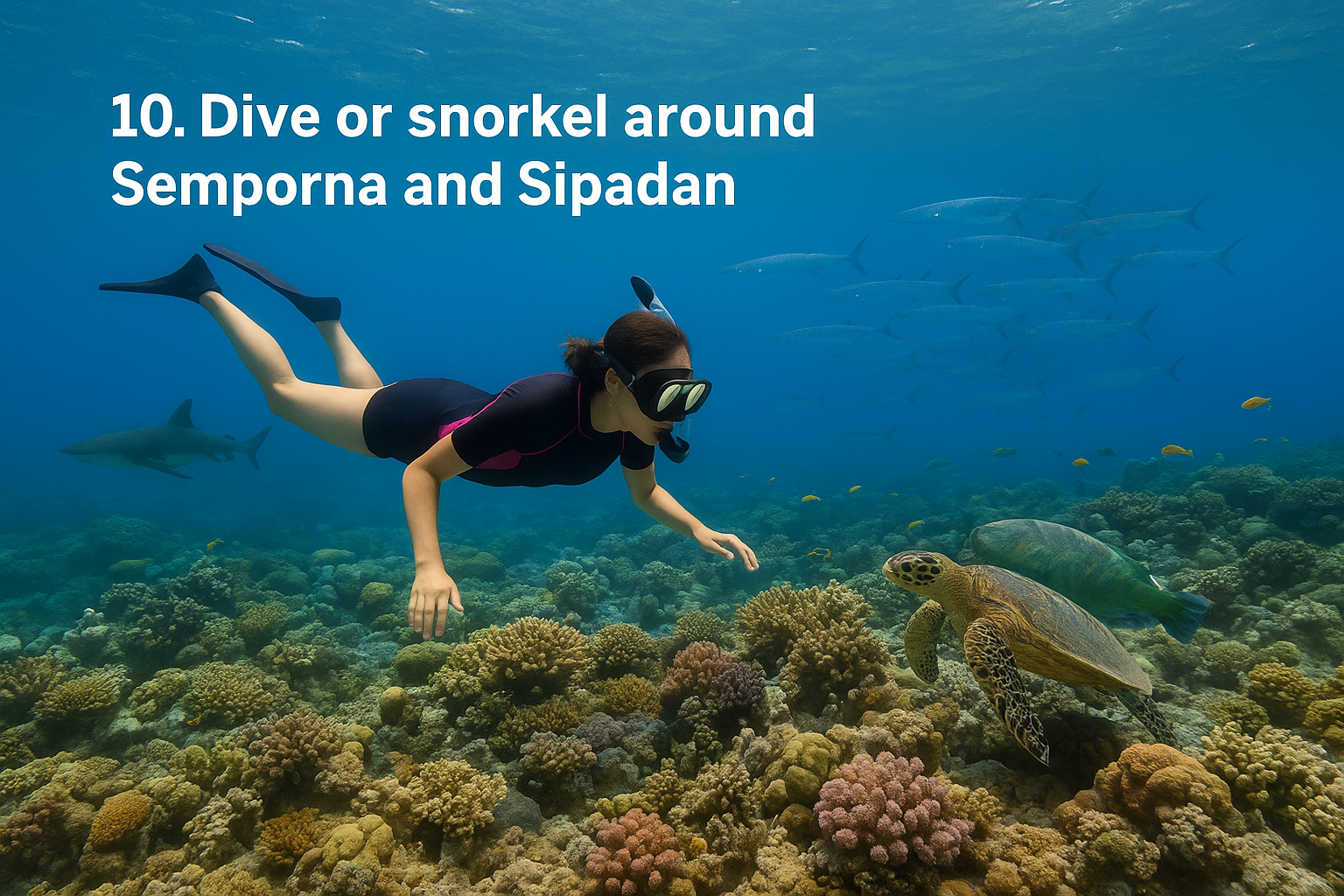
You join a boat out of Semporna to reach sites like Sipadan Island, Mabul, and Kapalai, where the reef systems support massive schools of barracuda, green and hawksbill turtles, and white-tip reef sharks. Snorkelers can cover the shallower reef edges around Mabul and still encounter exceptional marine life without a diving certification.
Why it's worth it
Sipadan ranks consistently among the top dive sites globally, and the daily permit cap of 120 divers keeps the reef in exceptional condition. The biodiversity here is genuinely dense, with hammerhead sharks and bumphead parrotfish moving through the water in numbers that most dive destinations can no longer offer.
Sipadan's permit system exists for a reason: the reef reflects exactly what controlled access does for a marine ecosystem over time.
How to plan it
Book your dive operator and Sipadan permit through a licensed resort in Semporna well ahead of your trip. Most operators bundle multiple site visits across two to three days.
Cost, timing, and tips
Budget around MYR 500 to MYR 900 per person per day covering permits, boat transfers, and equipment rental.
Best time to go
April through October gives you the best underwater visibility and the calmest sea conditions around Semporna.
11. Spot proboscis monkeys and fireflies on a river cruise
The Garama and Klias rivers near Beaufort offer one of the most distinctive experiences in any guide to what to do in Sabah Malaysia. This river cruise combines two completely different spectacles in a single evening, making it a strong addition to any itinerary.
What you'll do
You board a flat-bottomed boat in late afternoon and cruise through mangrove-lined waterways where proboscis monkeys gather in the trees before dusk. As darkness falls, the same river transforms into something unexpected: thousands of synchronized fireflies light up the mangrove branches along the bank, pulsing in patterns that cover entire stretches of shoreline.
Why it's worth it
Proboscis monkeys are endemic to Borneo and found nowhere else on Earth. Watching them drop from the canopy and settle in riverside trees for the night is a behavior you simply cannot see anywhere else. The firefly display that follows is equally striking.
Most travelers who combine both sightings in one trip describe the firefly stretch as the more memorable half of the evening.
How to plan it
Book through a day tour operator based in Kota Kinabalu or Beaufort, as most packages include transport, the boat cruise, and a simple meal. The full round trip from KK takes roughly six to seven hours.
Cost, timing, and tips
Budget around MYR 150 to MYR 250 per person for a full guided tour including transport. Depart KK by 2:00 PM to reach the river before sunset activity peaks.
Best time to go
April through October offers the most reliable proboscis monkey sightings and the clearest firefly displays along the Klias wetlands.
Next steps for your Sabah trip
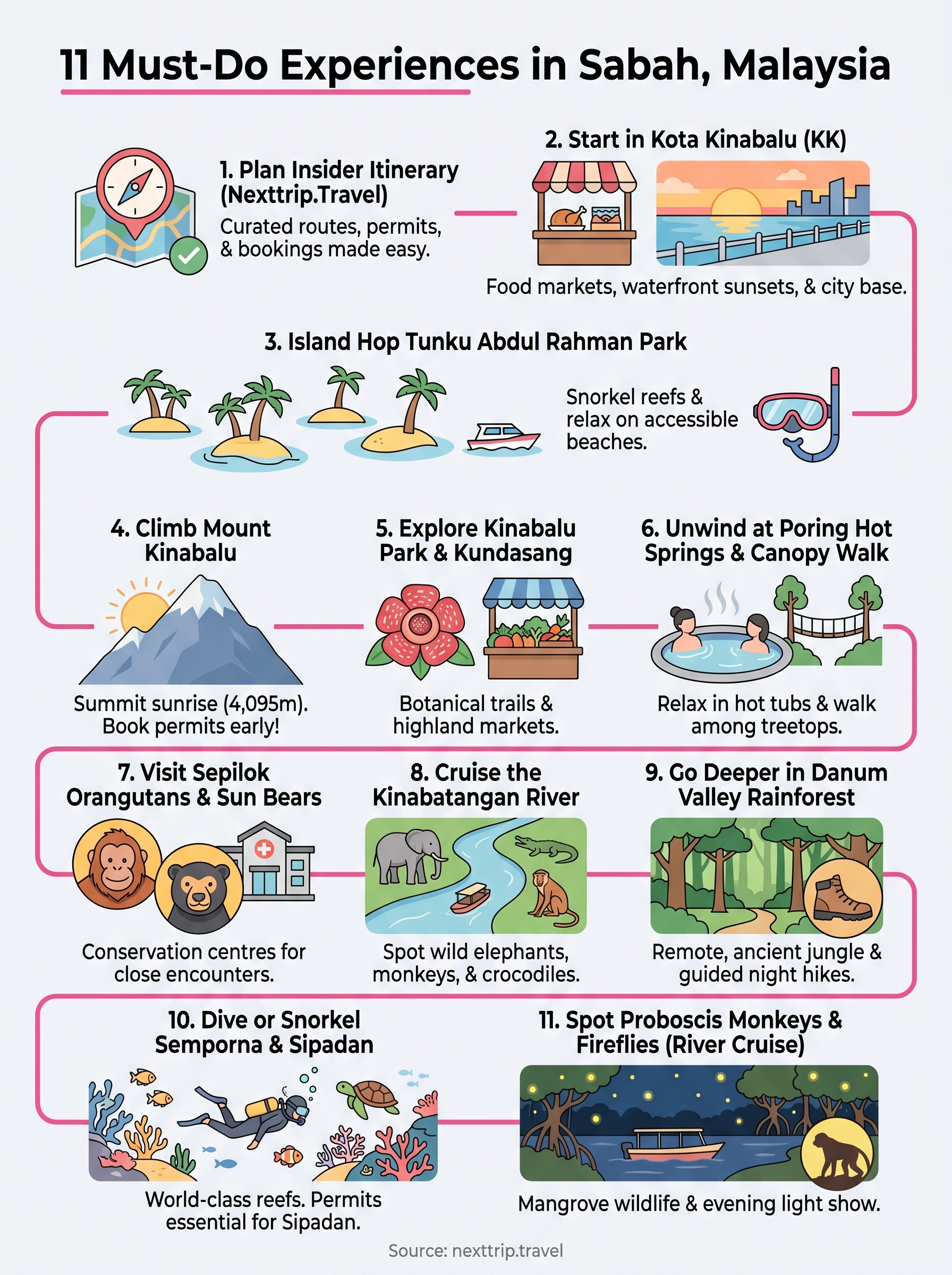
You now have a clear picture of what to do in Sabah, Malaysia, from summit sunrises on Kinabalu to firefly-lit mangroves along the Klias River. The challenge shifts from discovery to execution: locking in permits, sequencing your route, and booking the right lodges before availability closes out, especially during dry season when demand peaks across every major site.
Getting the order right matters as much as the activities themselves. A poorly sequenced itinerary burns travel days on unnecessary backtracking and leaves you rushing experiences that deserve more time. Climbing slots, Sipadan permits, and Kinabatangan lodges all fill months in advance, so the earlier you commit to a plan, the more options you keep open.
Skip the guesswork and start building your trip with a team that knows Sabah firsthand. Plan your Sabah itinerary with Nexttrip.Travel and get a curated route designed around your travel dates, interests, and budget.