

Malaysia doesn't have a single "good" or "bad" season, it has multiple climate zones that behave differently throughout the year. That's exactly why figuring out the best time to visit Malaysia depends on where you're headed, not just when you're free. A beach trip to Langkawi follows completely different weather patterns than a dive holiday in Sipadan or a city break in Kuala Lumpur.
At Nexttrip.Travel, we plan curated trips across Malaysia for travelers who want more than a generic package, and timing is one of the first things we help people get right. The difference between arriving during peak monsoon season versus a few weeks earlier can mean the difference between pristine snorkeling conditions and closed-down island resorts.
This guide breaks Malaysia down by month, by coast (East vs. West), and by Borneo, so you can match your travel dates to the specific region and activities you care about. Whether you're chasing dry beach weather, festival seasons, or lower prices, you'll find the timing details here to plan with confidence rather than guesswork.
Why "best time to visit Malaysia" depends on where you go
Malaysia sits just above the equator, which means it stays warm all year. But warm doesn't mean the weather is predictable, consistent, or the same across the country. The country spreads across two separate landmasses: Peninsular Malaysia, which includes Kuala Lumpur, Langkawi, and Penang, and Malaysian Borneo, which covers Sabah and Sarawak. Each sits under a different set of monsoon patterns, meaning the best time to visit Malaysia in one region can genuinely be the worst time to visit another.
Three distinct regions, three different weather systems
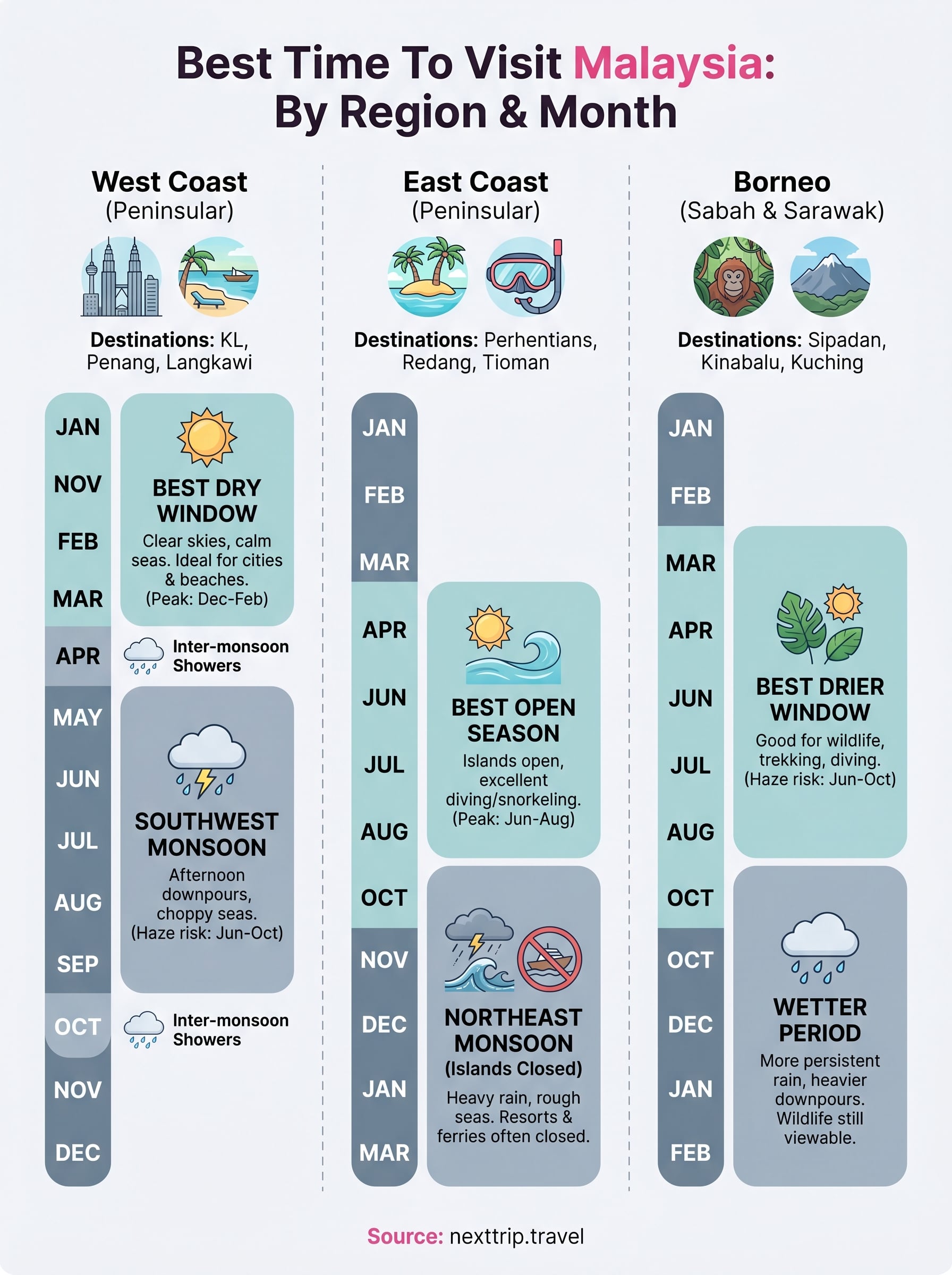
Peninsular Malaysia splits into west coast and east coast, and both coasts experience opposite monsoon seasons. The west coast, covering Kuala Lumpur, Penang, and Langkawi, gets the Southwest Monsoon from around May through September. The east coast, covering the Perhentian Islands, Redang, and Tioman, gets shut down by the Northeast Monsoon from November through February or March, when many island resorts close completely. These aren't subtle seasonal shifts. They're hard stops on travel.
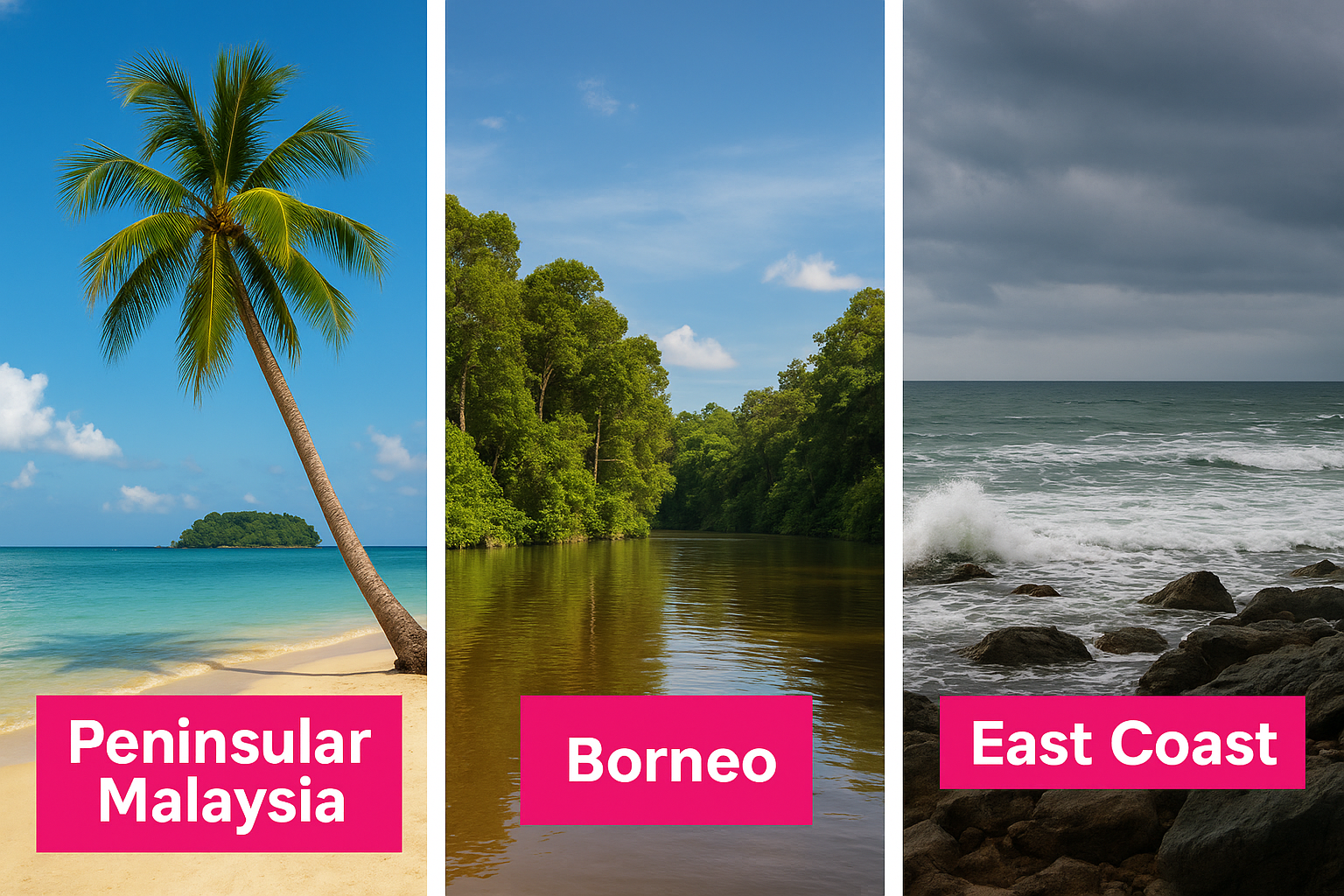
Borneo operates on a third weather pattern. Sabah and Sarawak receive rainfall throughout the year, but they have a drier window that runs roughly from March to October. Understanding which of these three regions you're visiting is the first step to getting your timing right. The table below gives you the essential overview before we go deeper into each one.
| Region | Main Monsoon Period | Best Dry Window |
|---|---|---|
| West Coast (Peninsular) | May to September | November to March |
| East Coast (Peninsular) | November to March | April to October |
| Borneo (Sabah and Sarawak) | October to February | March to October |
West coast vs. east coast: opposite monsoon calendars
This is the detail most travelers miss when they start planning. If you book Langkawi in July, you're heading into the wettest stretch of the year on the west coast. If you book the Perhentian Islands in December, you'll likely find guesthouses closed and seas too rough to enter the water. These two coastlines operate on calendars that are almost perfectly reversed.
Planning beach time on both coasts during the same trip requires careful scheduling, because the windows that work for one side rarely overlap with the other.
Your itinerary needs to account for this split upfront. If you want to combine a stay in Kuala Lumpur with east coast beaches, April through early October gives you the best overlap. If you're pairing KL with Langkawi or Penang, November through February is the better window. Getting this wrong doesn't just mean occasional showers. It can mean dealing with closed attractions, rough seas, and disrupted transport.
Borneo is its own weather story
Sabah and Sarawak sit outside the peninsular monsoon cycle entirely. Rain is possible any month, but the drier period from March through October gives you calmer conditions for wildlife watching along the Kinabatangan River, diving at Sipadan, and trekking through Mulu National Park. The wetter months from October to February bring heavier, more persistent downpours that can affect river access and trail safety.
Even during the dry window, expect afternoon showers. What changes is the frequency and intensity, not the total absence of rain. Travelers who factor in that variability and build some flexibility into their Borneo schedule consistently report better experiences than those who expect every day to be clear. Planning a half-day buffer around key activities like wildlife river cruises or summit climbs is a practical habit that pays off.
Malaysia weather basics: monsoons, heat, and haze
Malaysia sits close enough to the equator that temperatures stay high year-round, hovering between 25°C and 35°C across most of the country. What actually changes through the year isn't the heat, it's the rainfall pattern, which is driven by two monsoon systems that sweep across the region at different times. Understanding those systems is what makes the difference between a well-timed trip and one that gets rained out.
How the monsoons actually work
The country experiences two main monsoon seasons that hit different parts of Malaysia at different times. The Northeast Monsoon, which runs from November through March, brings heavy rainfall to the east coast of Peninsular Malaysia and parts of eastern Sabah. The Southwest Monsoon, running from May through September, brings wetter conditions to the west coast of the peninsula, including Kuala Lumpur, Penang, and Langkawi. Between these two cycles, you get inter-monsoon periods in April and October, which bring their own short but intense afternoon thunderstorms almost everywhere.
The inter-monsoon periods are often overlooked in travel planning, but they can bring some of the heaviest localized downpours of the year, even if they don't last long.
The monsoons don't switch on like a tap. Rainfall builds gradually at the start of each cycle and fades at the end. The core months of each monsoon, roughly December to February for the northeast and June to August for the southwest, tend to deliver the most sustained and disruptive weather. Knowing exactly which months mark the peak of each system helps you decide whether to shift your travel dates by a few weeks in either direction.
Heat, humidity, and the haze problem
Beyond the rain, humidity is a constant presence throughout Malaysia. Even during the driest months, the air feels thick and warm. Most coastal destinations sit at 70 to 90 percent relative humidity for most of the year, which affects how comfortable outdoor activity feels. Inland highland areas like Cameron Highlands and Genting offer cooler relief, with temperatures dropping to around 15°C to 25°C at elevation.
Haze is a separate issue that affects the Klang Valley and parts of Borneo between June and October, caused by agricultural fires burning in neighboring Sumatra and Kalimantan. During bad haze years, air quality drops sharply and outdoor visibility falls significantly. If you're searching for the best time to visit Malaysia with clean air in mind, planning your trip outside the June-to-October window reduces your exposure to haze considerably.
Best time for the west coast and Kuala Lumpur
The west coast of Peninsular Malaysia covers the country's most visited destinations: Kuala Lumpur, Penang, Langkawi, and the Perak region. This side of the peninsula faces the Strait of Malacca, and it comes under the influence of the Southwest Monsoon between May and September. If your trip centers on these destinations, knowing that window is the single most useful piece of weather information you can carry.
November to March: the dry season window
For the west coast, November through March is the clearest and most reliable stretch of the year. Rainfall drops significantly, skies stay brighter for longer stretches, and outdoor activities from beach days in Langkawi to rooftop dining in Kuala Lumpur become far more enjoyable. This is also the period when tourist numbers climb, so expect higher hotel rates and busier attractions, particularly in December around the Christmas and New Year period.
If you're looking for the best time to visit Malaysia on the west coast without fighting peak crowds, late January through early March hits the sweet spot: the rains have eased, school holiday pricing has dropped, and you still get reliable dry weather.
January and February also bring Chinese New Year, which is one of the most vibrant cultural events on the Malaysian calendar. Penang's Georgetown and Kuala Lumpur's Chinatown both come alive with lanterns, street performances, and open-house traditions. Traveling around this period is rewarding culturally, but you should book accommodation several weeks in advance since prices rise sharply for the holiday window.
What to expect during the Southwest Monsoon
From May through September, the west coast enters its wetter period. Kuala Lumpur sees regular afternoon downpours that typically last one to two hours before clearing. For a city trip, this level of rainfall is manageable since you spend time in air-conditioned malls, museums, and restaurants anyway. Langkawi and Penang, however, see noticeably rougher sea conditions and more persistent cloud cover during peak monsoon months of June, July, and August.
Traveling to Langkawi in July or August means you may encounter choppy waters, limited visibility for snorkeling, and some beach operators scaling back activities. The island doesn't shut down the way the east coast islands do, but the experience is meaningfully different from what you'd get in December or February. If your main goal is calm blue water and dry beach afternoons, shifting your west coast beach time to the November to March window gives you a significantly better chance of that.
Best time for the east coast islands and beaches
The east coast of Peninsular Malaysia is home to some of the most stunning beach destinations in Southeast Asia, including the Perhentian Islands, Redang, Tioman, and the Kapas Island. Unlike the west coast, this coastline faces the South China Sea, which means it takes the full force of the Northeast Monsoon from November through March. Getting your timing right here matters more than almost anywhere else in the country, because the difference between an open island and a closed one is measured in weeks.
April to October: the open season
For most east coast islands, April marks the start of the accessible season, when ferry services resume and resorts reopen after months of closure. Water visibility improves quickly from April onward, and by May the diving and snorkeling conditions at Redang and the Perhentians are consistently excellent. Underwater visibility can reach 20 meters or more during the peak dry months, making this stretch of coastline one of the best dive windows in the region.
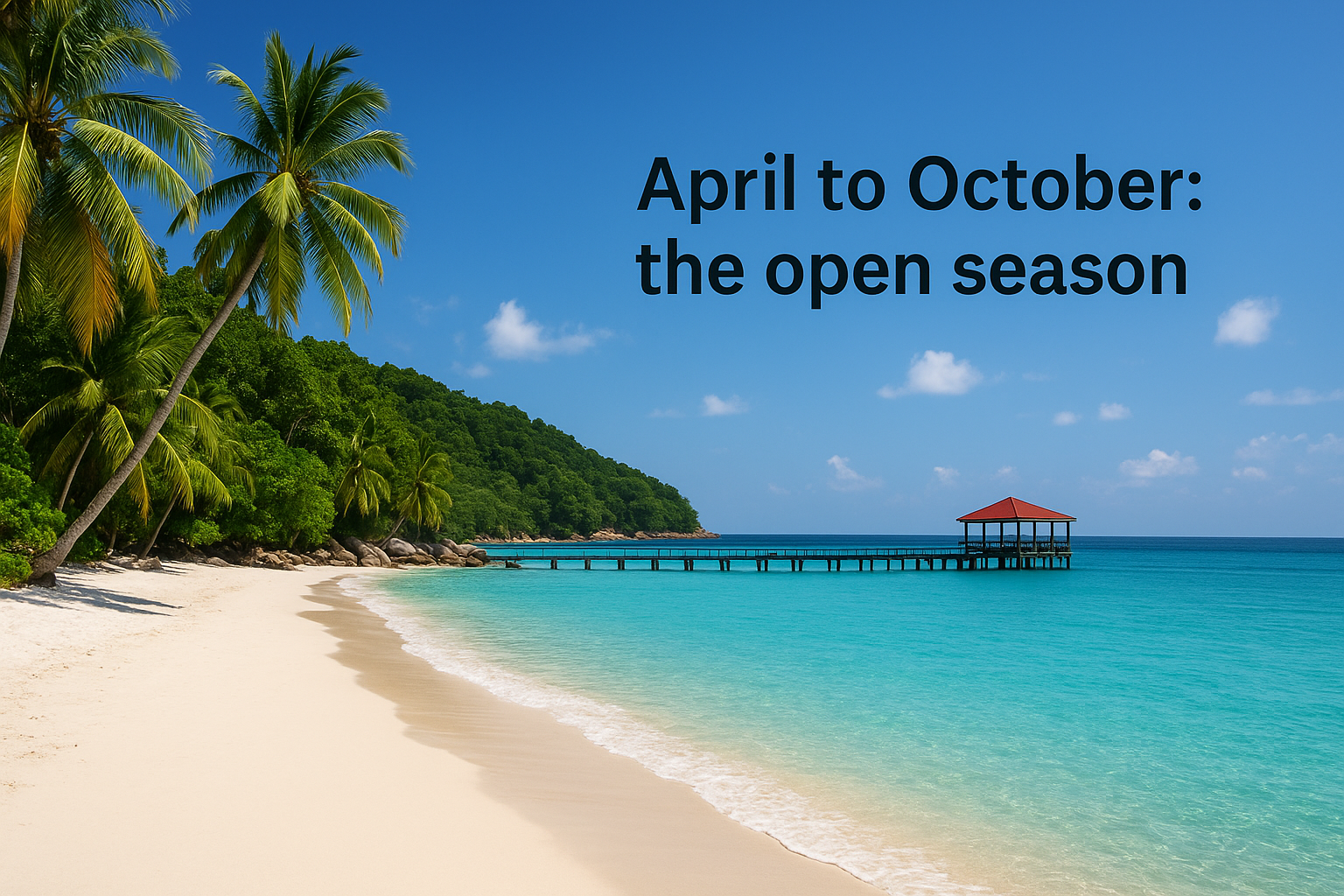
If finding the best time to visit Malaysia specifically for beach and dive holidays is your goal, May through September on the east coast gives you the most reliable combination of calm seas, clear water, and fully operational resorts.
June through August represents peak season on the east coast. Resorts fill up fast, prices climb, and popular dive sites get crowded. Booking your accommodation and diving packages at least six to eight weeks in advance is not an overreaction during this window. September and early October offer a useful alternative: conditions remain good, crowds thin out, and rates start to drop before the monsoon pushes everyone off the islands again.
November to March: when the islands close
From November onward, the Northeast Monsoon begins to build across the South China Sea, and the east coast takes the impact directly. Wave heights increase, ferry crossings become unsafe, and most resort operators on the Perhentians and Redang shut down completely for the season. Tioman sometimes stays partially open, but water conditions are rough and the experience is a fraction of what you get during peak months.
Traveling to east coast beaches between December and February is genuinely not recommended, regardless of how good a deal the flights look. The risk is not just bad weather; it's arriving to find limited transport options, closed guesthouses, and seas that make any water activity impossible. Shifting your east coast plans by even four to six weeks in either direction puts you in a completely different experience category.
Best time to visit Malaysian Borneo: Sabah and Sarawak
Borneo operates on a different schedule from Peninsular Malaysia, and that distinction changes everything about how you plan. Sabah and Sarawak don't follow the northeast or southwest monsoon patterns that govern the peninsula. Instead, both states receive rainfall throughout the year, with a relatively drier and more predictable window that makes certain months significantly better for outdoor activities, wildlife, and diving than others.
March to October: the best window for most activities
For most travelers asking about the best time to visit Malaysia's Borneo states, March through October delivers the most favorable conditions. Rainfall still occurs during this period, particularly in the afternoons, but the frequency and duration of heavy downpours drops considerably compared to the wetter months. River levels and trail conditions in places like Kinabalu National Park and Mulu's cave systems are more manageable, and wildlife activity along the Kinabatangan River is easier to access when boat passage stays clear.
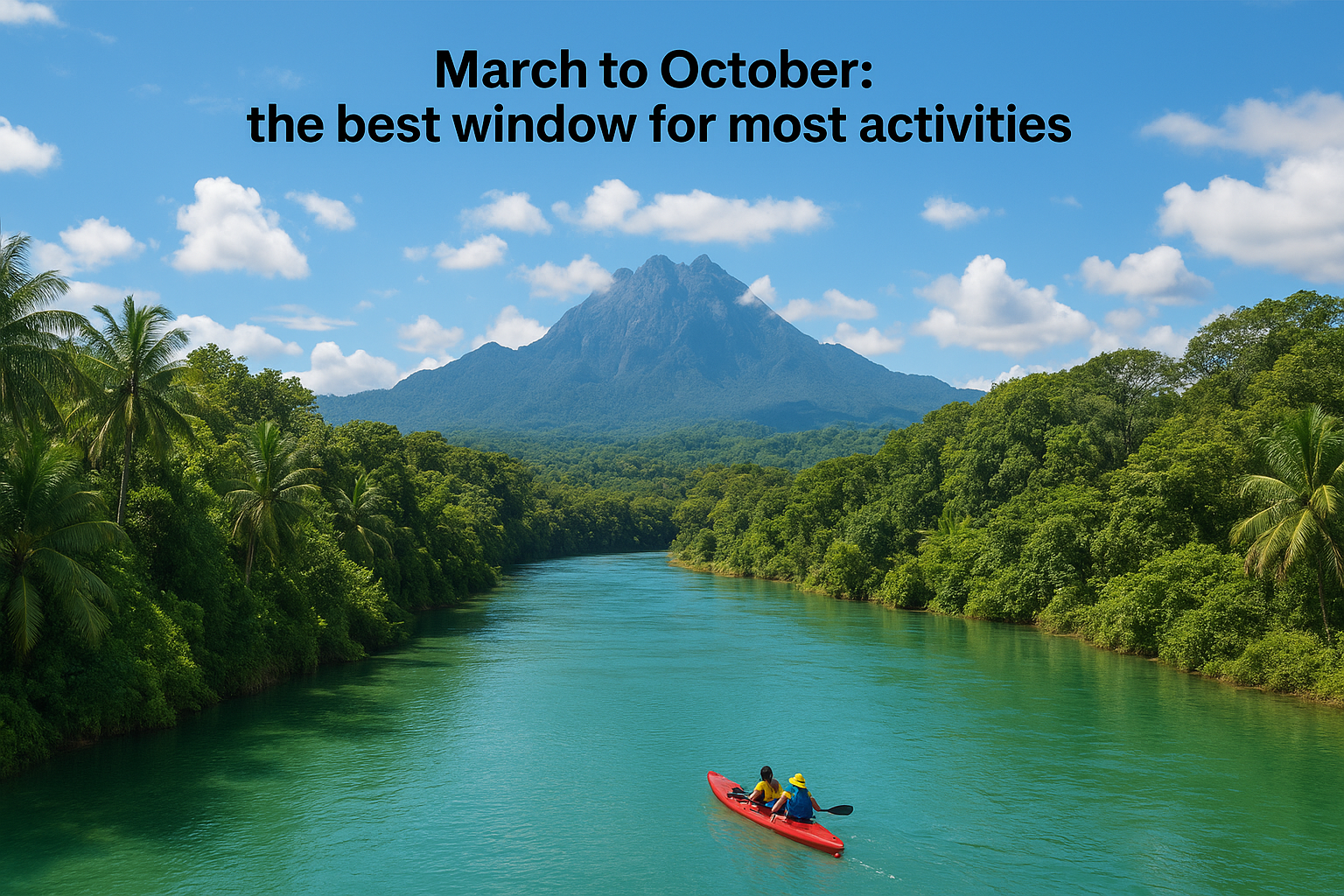
Sipadan, widely regarded as one of the top dive sites in the world, operates best between April and September when water visibility regularly exceeds 20 meters and current conditions suit both beginners and experienced divers.
Sabah's famous Mount Kinabalu climbs are also best attempted during this window. Rain and mist still appear, but the summit attempts between April and August give you a statistically better chance of clear skies at the top. Booking your climb permit well in advance is essential since daily quotas fill months ahead during peak season.
October to February: heavier rain, but still worth it
From October through February, Borneo's rainfall intensifies across much of Sabah and Sarawak. River trips can face disruptions, some jungle trails become slippery and slow, and the Kinabatangan region occasionally floods in ways that limit boat movement. That said, Borneo doesn't shut down the way the east coast peninsula does. Resorts stay open, most dive operators continue running, and the wildlife doesn't disappear.
Sarawak's longhouse cultural experiences and urban highlights in Kuching remain accessible and enjoyable regardless of the season, since they don't depend on outdoor weather windows the same way beach or jungle activities do. If Borneo culture, food, and history are your primary interests rather than trekking or diving, the wetter months still deliver a rewarding trip. Traveling with flexible scheduling built into your itinerary, so a washed-out afternoon doesn't derail a key activity, makes the biggest practical difference during this period.
Malaysia by month: what to expect from January to December
No single month works perfectly for every region of Malaysia at the same time, which is the core challenge when identifying the best time to visit Malaysia for a multi-destination trip. The table below gives you a fast reference for what each month delivers across the three main regions before we break down the key seasonal windows in more detail.
| Month | West Coast | East Coast | Borneo |
|---|---|---|---|
| January | Dry, pleasant | Monsoon, closed islands | Wetter, limited trails |
| February | Dry, Chinese New Year | Monsoon easing | Wetter |
| March | Dry, warming | Season opens | Drier window starts |
| April | Inter-monsoon showers | Open, good diving | Good conditions |
| May | Wetter starts | Peak season begins | Good conditions |
| June | Wetter, haze risk | Peak season | Good, haze risk |
| July | Wetter, haze risk | Peak season | Good, haze risk |
| August | Wetter, haze risk | Peak season | Good, haze risk |
| September | Improving | Season winds down | Good conditions |
| October | Dry window starts | Inter-monsoon | Wetter starts |
| November | Dry, good | Monsoon building | Wetter |
| December | Dry, busy | Monsoon, most islands close | Wetter |
January to March: the west coast sweet spot
January and February are the most reliable months on the west coast, with low rainfall and clear conditions in Langkawi, Penang, and Kuala Lumpur. February brings Chinese New Year, which adds cultural energy to cities but pushes hotel prices up for about two weeks. On the east coast, the Northeast Monsoon is still active through February, and most island resorts remain closed until late March.
April to June: transition and opportunity
April sits in the inter-monsoon window, which means short but intense afternoon storms can appear almost anywhere. Despite that, east coast islands open from April onward, and diving conditions at Redang and the Perhentians improve quickly. The west coast starts getting wetter from May, but Kuala Lumpur remains very manageable for a city trip throughout this stretch.
July to September: east coast peaks, west coast copes
July and August mark the peak of east coast beach season, with the best diving visibility and fully booked resorts. The west coast deals with its heaviest rainfall and potential haze during these months, making Langkawi a less rewarding beach destination. September offers a useful transition: east coast conditions stay good while prices begin to ease, and the west coast starts drying out heading into October.
October to December: the seasons reverse
October brings the inter-monsoon transition again, with unpredictable showers across most of the country. By November, the east coast monsoon is building and island access becomes unreliable. The west coast, however, moves into its dry season from November onward, making December a strong month for Penang, Langkawi, and Kuala Lumpur despite the higher prices that come with the holiday period.
Best time for activities: beaches, wildlife, hikes, shopping
When you're deciding on the best time to visit Malaysia, matching your travel dates to your specific activities matters more than picking a single "good" month. Beaches, wildlife, trekking, and shopping each follow their own seasonal rhythms, and knowing those rhythms gives you a much sharper planning advantage than a general weather forecast ever will.
Beaches: matching the coast to your dates
Your beach timing depends entirely on which coastline you're targeting. East coast beaches at Redang, the Perhentians, and Tioman deliver their best conditions from May through September, with calm seas, strong visibility, and fully operational dive operators. West coast beaches in Langkawi and Penang work best from November through March, when rainfall drops and sea conditions settle.
Trying to do both coastlines in one trip is absolutely possible, but you need to sequence them carefully rather than picking a single travel window and hoping both work out.
Wildlife watching: timing around Borneo's seasons
Borneo offers some of the most rewarding wildlife encounters in Southeast Asia, and your timing shapes what you actually see. Orangutan sightings at Sepilok and Semenggoh are possible year-round, but river wildlife cruises along the Kinabatangan River in Sabah are most productive between March and October when water levels are lower and animals concentrate near the riverbanks. Sea turtle nesting at Selingan Island runs from July through October, making that a particularly strong window for travelers combining diving and wildlife in Sabah.
Hiking: planning around heat and wet trails
Malaysia's highland trails vary significantly in accessibility depending on the season. Mount Kinabalu in Sabah is best attempted between April and August, when summit conditions are drier and you have a better chance of clear views from the top. Permit slots fill months in advance during this window, so booking early is essential rather than optional. Cameron Highlands in Peninsular Malaysia works well year-round since its elevation keeps temperatures mild, though the October inter-monsoon period brings heavier rain that makes trail footing slippery and less enjoyable.
Shopping: festivals and sale seasons
Malaysia's shopping calendar rewards travelers who time their visits around key retail events. Kuala Lumpur's year-end sales run from November through January, coinciding with the dry season on the west coast and making December a strong all-round month for city-focused trips. The Malaysia Year-End Sale and Chinese New Year shopping period in January and February brings significant discounts at major malls like Pavilion and Suria KLCC. If shopping is a priority, pairing it with the dry west coast window from November to March gives you the best combination of comfortable weather and active sale periods.
Costs, crowds, and festival planning tips
Timing your trip around Malaysia's peak and shoulder seasons changes what you pay and how crowded your experience feels. The best time to visit Malaysia from a value standpoint isn't always the driest month. It's the period when weather and crowd levels both work in your favor, and knowing the festival calendar plays a bigger role in that equation than most travelers expect.
Peak season pricing and when crowds peak
Malaysia has two clear high-demand windows that push hotel prices and flight costs up across the country. The first runs from late November through early January, when the west coast enters its dry season and international visitors combine with domestic holiday travel around Christmas and New Year. The second sits in June through August, when school holidays drive families toward both coasts and Borneo. During both windows, popular resorts in Langkawi, the Perhentians, and Sipadan book out weeks or months in advance.
Booking accommodations six to eight weeks before your arrival during peak season is not cautious planning, it is the minimum required to avoid being priced out or locked out of your preferred options.
Shoulder months like March, April, September, and October offer a reliable alternative. Weather conditions are still workable across most regions, prices drop noticeably, and popular sites feel far less congested. If your schedule has any flexibility, shifting your arrival by two to three weeks around peak windows regularly delivers savings of 20 to 40 percent on accommodation.
Key festivals that affect travel costs and availability
Malaysia's festival calendar directly affects transport and hotel availability in ways that catch first-time visitors off guard. The three events that create the sharpest demand spikes are Chinese New Year (January or February), Hari Raya Aidilfitri (date shifts annually with the Islamic calendar), and Deepavali in October or November. During each of these, domestic travel surges, intercity bus and train tickets sell out fast, and Kuala Lumpur's city hotels often raise rates significantly.
The table below shows the main festivals to factor into your booking timeline.
| Festival | Typical Timing | Main Impact |
|---|---|---|
| Chinese New Year | January or February | Hotels spike in KL and Penang |
| Hari Raya Aidilfitri | Varies (Islamic calendar) | Transport books out nationwide |
| Deepavali | October or November | KL and Batu Caves area very busy |
| Malaysia Year-End Sale | November to January | KL malls crowded, good shopping deals |
Planning around these dates doesn't mean avoiding them. Experiencing Chinese New Year in Georgetown or Deepavali near Batu Caves is genuinely worth the extra booking effort. It does mean you need to lock in your flights and accommodation earlier than you normally would, rather than leaving it until a few weeks before departure.
Wrap-up and next steps
The best time to visit Malaysia comes down to where you're going and what you want to do when you get there. The west coast and Kuala Lumpur run best from November through March, the east coast islands open from April through October, and Borneo's most rewarding window stretches from March through October. Treat those three regions as separate planning decisions rather than one country-wide answer, and your timing will be far more accurate.
Your next step is to match those weather windows against your actual travel dates, your target activities, and the festivals that affect availability. Booking accommodation and transport early enough to have real options makes a bigger difference than any other single planning decision, particularly during peak months. If you want help putting those pieces together into a trip that actually works, explore our Malaysia travel planning options and let our team handle the details.